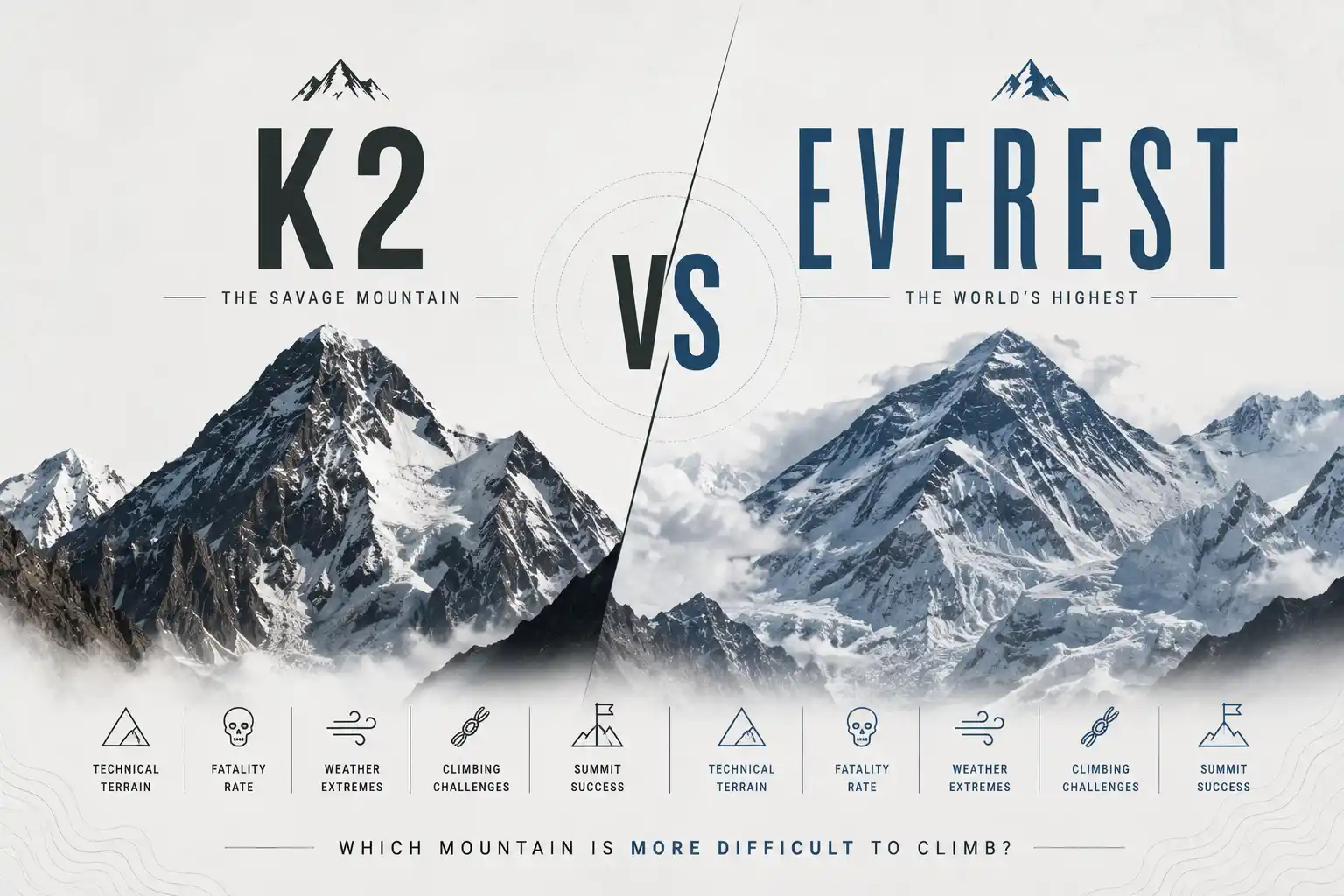
K2 vs Everest: Which Mountain Is More Difficult to Climb?
Which is more difficult, K2 or Everest?
It sounds like a straightforward question. Everest is the highest mountain on Earth, while K2 is only the second highest. So surely Everest should be harder, right?
Not quite.
When climbers compare K2 vs Everest, the answer most often comes down to one mountain being higher and the other being much more technical. Mount Everest reaches 8,848.86 metres, while K2 stands at 8,611 metres. Yet K2 has earned a reputation as one of the hardest mountains in the world to climb.
The reason is simple: altitude isn’t the only thing that makes a mountain difficult.
On Everest’s standard South Col route, climbers face extreme altitude, cold, crevasses, the Khumbu Icefall, steep sections and the long final push above 8,000 metres. K2, however, combines that same extreme altitude with sustained steep climbing, technical rock and ice, unpredictable weather and serious objective hazards.
So, which is harder, K2 or Everest?
For the standard routes, K2 is generally considered the more technically difficult and committing climb.
But that doesn’t make Everest easy.
Far from it.
K2 vs Everest: The Basic Difference
Before comparing the two mountains, it helps to understand what makes them difficult in different ways.
Everest is the highest mountain in the world. Its standard South Col route takes climbers through the Khumbu Icefall, Western Cwm, Lhotse Face, South Col and the summit ridge before reaching the top. Fixed ropes, established camps, experienced Sherpa teams and supplemental oxygen have made the standard route more accessible than many other 8,000-metre peaks.
K2 is lower, but the standard Abruzzi Spur is considerably more technical. Climbers encounter steep rock and ice, the House’s Chimney, Black Pyramid, the Shoulder and the notorious Bottleneck before reaching the summit ridge.
There are fewer sections where you can simply walk.
Much more of the route demands actual climbing.
As mountaineer Alan Arnette, who has climbed both Everest and K2, has explained, Everest is heavily dominated by the challenge of altitude, while K2 combines extreme altitude with sustained technical climbing.
Is K2 Harder Than Everest?
Yes, if we’re talking about technical climbing difficulty on the normal routes.
K2’s standard route is steeper and more sustained. Climbers have to use their hands and feet on sections of rock and ice while operating in an environment where a mistake can have catastrophic consequences.
The mountain also offers fewer opportunities to relax.
On Everest, there are long sections of relatively moderate terrain between the major technical challenges. That doesn’t make them safe; the altitude alone makes every step difficult. But the climbing itself is generally less demanding on the standard South Col route.
K2 is different.
The technical sections can continue for long stretches, and climbers remain exposed to steep terrain at extreme altitude.
That is one of the biggest reasons K2 is harder than Everest for experienced mountaineers.
Why Is K2 So Difficult?
K2’s reputation doesn’t come from one single obstacle.
It comes from the combination of several problems.
The Terrain Is Steeper
The Abruzzi Spur involves sustained steep climbing on rock, snow and ice.
Instead of simply walking uphill for long stretches, climbers often need to actively climb using crampons, ice tools, ropes and their hands.
The difference becomes particularly important when you’re doing it at 7,000 or 8,000 metres.
At sea level, a steep climbing pitch is difficult.
At extreme altitude, even simple movement becomes exhausting.
The Bottleneck Is Extremely Dangerous
One of K2’s most notorious sections is the Bottleneck, a steep couloir beneath large hanging seracs.
Climbers have to pass through this exposed section while knowing that falling ice is a serious objective hazard.
The 2008 K2 disaster demonstrated just how dangerous the area can become when falling ice and damaged fixed ropes combine with climbers trying to descend.
The problem isn’t simply whether you are technically capable of climbing it.
You also have to be there at the right time, in the right conditions.
Why Is Everest Still Extremely Difficult?
It would be a mistake to read this comparison and assume Everest is easy.
It isn’t.
In fact, climbing Mount Everest is one of the most demanding things a human can attempt.
The difference is that much of Everest’s difficulty comes from altitude rather than sustained technical climbing.
At 8,848.86 metres, the summit is well inside the so-called Death Zone, where the human body cannot acclimatize indefinitely. Every movement becomes slower and more exhausting, while cold, wind and low oxygen increase the danger.
Then there is the Khumbu Icefall.
The route through the icefall involves crevasses, ladders and unstable blocks of ice. Conditions can change, and the route has to be continually managed by experienced mountain workers.
The Lhotse Face provides another major challenge, followed by the final summit ridge.
Even on a fixed rope, you’re still climbing the highest mountain on Earth.
K2 vs Everest: Which Has More Technical Climbing?
This is where the difference becomes especially clear.
On Everest’s standard South Col route, fixed ropes and established infrastructure make many sections more straightforward from a technical climbing perspective. Climbers still need skills with crampons, ice axes, ropes and crevasse travel, but much of the route is closer to steep high-altitude climbing than sustained technical rock and ice climbing.
K2 demands more.
The Abruzzi Spur includes technical sections such as House’s Chimney and the Black Pyramid, followed by steep terrain higher on the mountain.
According to experienced K2 climber Alan Arnette, K2 is steeper and more sustained, with technical sections that continue for much longer than comparable sections on many other major peaks.
That’s why experienced mountaineers generally place K2 above Everest in terms of technical difficulty.
Which Mountain Has Worse Weather?
Both mountains can experience brutal weather.
However, K2 has a particularly dangerous reputation for its weather because conditions can change quickly and usable summit windows can be short.
Its location in the Karakoram also contributes to the mountain’s harsh environment.
A climber can be technically strong and still be forced to turn around because the weather has become unsafe.
Everest also experiences extreme winds, snowfall and rapidly changing conditions. However, its greater number of expeditions and better-established infrastructure provide climbers with considerably more information and support when planning summit attempts.
Weather remains one of the biggest factors on both mountains.
No amount of fitness can make a bad weather window safe.
Is K2 More Dangerous Than Everest?
Generally, yes, when comparing the normal routes and historical risk.
But this is where statistics can become misleading.
Everest has had far more climbers and far more total deaths simply because vastly more people attempt it. K2 has seen a fraction of Everest’s traffic.
The more useful comparison is the risk relative to the number of climbers or successful summits, and by those measures K2 has historically been much more lethal. Older Himalayan Database research, for example, found substantially higher descent mortality on K2 than Everest during the period studied.
More recent analyses also continue to show a significant difference between the two mountains, although the exact percentage changes depending on the dataset and denominator being used.
So it is better not to throw around a single dramatic percentage without explaining what it actually measures.
The important point is this:
K2 gives climbers less room for error.
Why Is Everest Easier Than K2 for Some Climbers?
There is another major reason the K2 vs Everest comparison can be confusing.
Everest has developed an enormous climbing infrastructure.
There are established commercial expedition companies, fixed ropes, stocked camps, weather forecasts, high-altitude Sherpa teams, oxygen logistics and decades of accumulated knowledge about the standard routes.
That doesn’t remove the danger.
It simply means that climbers attempting Everest’s standard route have access to a level of support that is difficult to match on K2.
K2 has become more commercial in recent years too, but it remains a far more committing mountain.
As Arnette notes from his own experience, K2 still requires a much stronger set of technical and alpine skills than the standard Everest route.
Does Summiting Everest Mean You Are Ready for K2?
Not necessarily.
This might be the biggest misconception surrounding the two mountains.
Someone can successfully climb Everest and still not be prepared for K2.
Everest experience gives a climber valuable knowledge about altitude, expedition life and climbing at 8,000 metres. But K2 requires additional technical ability and experience on steep rock, ice and mixed terrain.
In other words:
Everest experience helps. It doesn’t automatically qualify someone for K2.
A climber preparing for K2 would normally need substantial experience on technically difficult mountains before attempting it.
K2 vs Everest: Quick Comparison
| Factor | Mount Everest | K2 |
|---|---|---|
| Height | 8,848.86 m | 8,611 m |
| Rank | Highest mountain in the world | Second-highest |
| Standard route | South Col | Abruzzi Spur |
| Main challenge | Extreme altitude + endurance | Technical climbing + altitude |
| Terrain | Steep snow and ice with technical sections | Sustained steep rock, ice and mixed terrain |
| Weather | Extremely severe | Extremely severe and often less predictable |
| Infrastructure | Extensive | More limited |
| Traffic | Very high | Much lower |
| Technical difficulty | High | Very high |
| Overall difficulty | Extreme | Generally considered harder |
So, Which Is Harder: K2 or Everest?
If you force mountaineers to choose one answer, K2 generally wins the difficulty argument.
Everest is higher.
Everest has its own serious technical sections.
Everest exposes climbers to extreme altitude for long periods.
But K2 combines extreme altitude with more sustained technical climbing, steep terrain, objective hazards and fewer opportunities to recover.
That’s what makes the mountain so intimidating.
Perhaps the simplest way to describe the difference is this:
Everest asks, “Can your body survive the altitude?”
K2 asks, “Can you keep climbing technically difficult terrain while your body is already struggling at extreme altitude?”
And that is a very different question.
The Bottom Line
The K2 vs Everest debate isn’t really about which mountain is “easy.”
Neither is.
Everest is the highest point on Earth and remains one of the most dangerous environments humans voluntarily enter. K2 is lower, but its standard route is steeper, more technical and generally more committing.
That’s why K2 has earned the nickname “The Savage Mountain.”
Everest may be the mountain everyone knows.
K2 is the mountain that climbers often fear.
And perhaps that’s what makes the comparison so fascinating.
Everest is higher. K2 is harder.
For experienced mountaineers comparing the standard routes, that’s about as close to a simple answer as you can get.
Follow us on Instagram for Regular Updates!

Recent Posts

Is Gulabi Kantha Trek Worth It? An Honest Guide for 2026


Is Kedarkantha Difficult for Beginners? An Honest 2026 Guide
Quick booking process
+91 9557062166