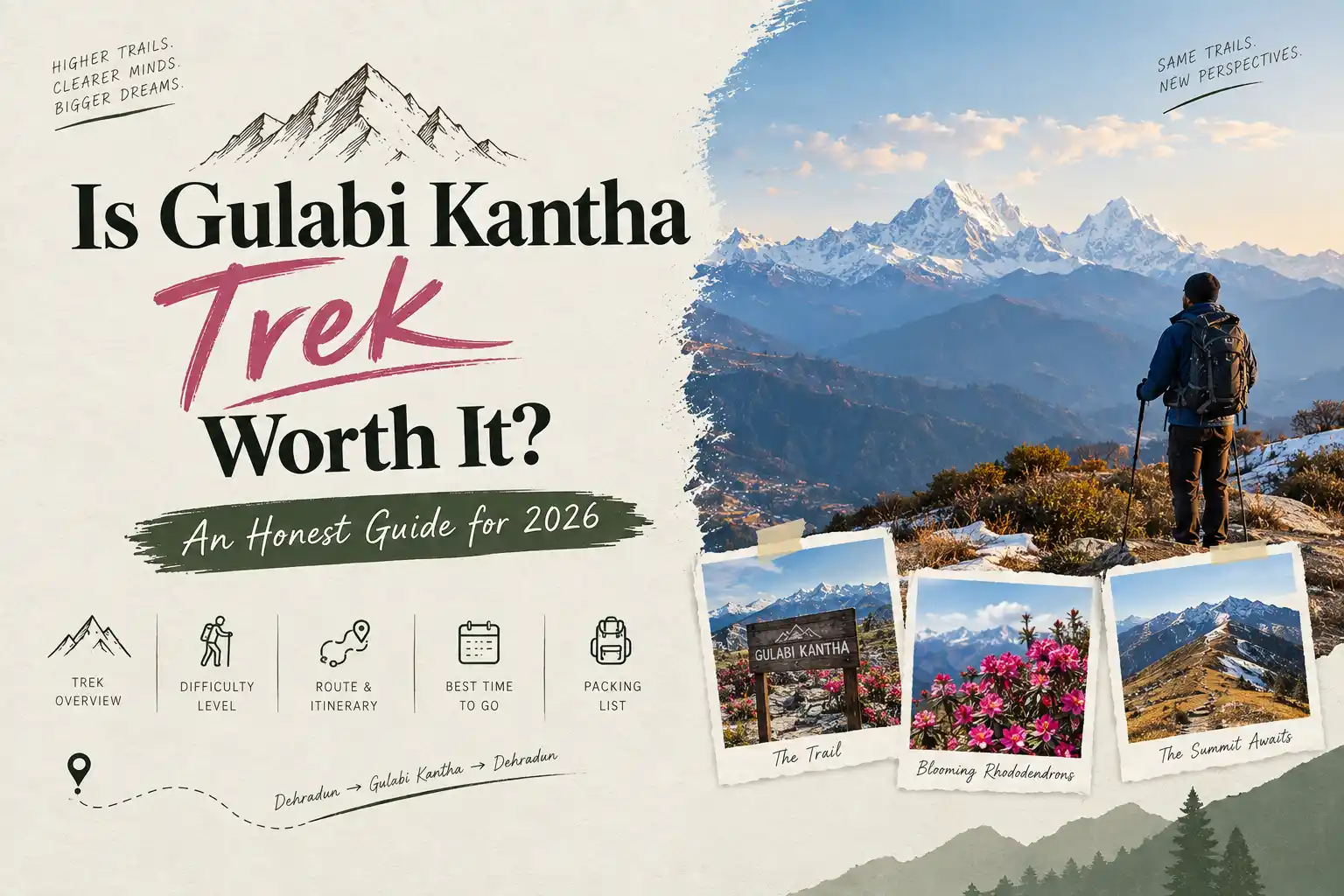
Is Gulabi Kantha Trek Worth It? An Honest Guide for 2026
If you are wondering “Is Gulabi Kantha Trek worth it?”, the short answer depends on what you want from a Himalayan trek. If your idea of a good trek includes peaceful trails, huge alpine meadows, Himalayan views, forest walks and a summit without the crowds found on some of Uttarakhand’s better-known routes, Gulabi Kantha deserves a serious look. The trek was selected as Uttarakhand’s Trek of the Year 2025, bringing new attention to a route that was previously far less known.
But is the hype justified? And how does Gulabi Kantha compare with more popular treks such as Kedarkantha or Dayara Bugyal?
Let’s look at what the trek actually offers.
What Makes Gulabi Kantha Trek Special?
Gulabi Kantha is located in the Yamuna Valley of Uttarkashi, Uttarakhand, with Hanuman Chatti serving as the usual starting point. The trail moves through forests, small mountain settlements and wide high-altitude meadows before reaching the Gulabi Kantha summit.
The trek reaches approximately 13,200 feet, although published route information varies slightly on the exact summit measurement and total trekking distance. The route is generally described as easy to moderate or moderate, depending on the itinerary and season.
That combination is what makes the trek interesting: you get a proper high-altitude summit experience without needing a technical climbing background.
And then there are the views.
From the higher sections, clear weather can reveal mountains including Bandarpunch, Swargarohini, Jaonli and parts of the Gangotri massif. The summit also offers a broad Himalayan panorama rather than a view restricted to one direction.
So, Is Gulabi Kantha Trek Worth It?
Yes, if you want an offbeat Himalayan experience
One of the biggest reasons Gulabi Kantha Trek is worth it is that the trail still feels relatively quiet compared with several established Himalayan trekking routes.
You are not simply walking from one famous campsite to another. The journey includes forests, meadows, villages and open mountain landscapes. That variety makes the trail feel like a complete Himalayan experience rather than just a summit climb.
The route has also started attracting more attention since its Trek of the Year recognition. Even so, recent trekking accounts continue to describe it as a comparatively less-explored trail.
If solitude and scenery matter more to you than ticking off the most famous trek in Uttarakhand, that is a significant advantage.
The Meadows Are One of the Biggest Highlights
If you have never experienced a Himalayan bugyal, Gulabi Kantha gives you a memorable introduction.
The trail opens into broad meadows around Seema Thatch, where the landscape changes dramatically after the forest sections. Depending on the season, these open slopes can appear green, covered with flowers or blanketed in snow.
Spring brings rhododendron blooms, while the warmer months bring greenery and alpine flowers. Autumn can offer clearer skies and better mountain visibility. Winter, meanwhile, can transform the same landscape into a snow-covered trail.
That seasonal variation is another reason Gulabi Kantha Trek is worth considering.
You can essentially experience a different version of the same trek depending on when you go.
Gulabi Kantha Summit: Is the Climb Worth It?
The summit day is where the trek earns its name.
From the upper meadow, the trail climbs towards the Gulabi Kantha summit at around 13,200 feet. The final ascent is more demanding than the earlier forest sections, particularly when snow or poor weather makes the trail slower.
But the reward is not just reaching a numbered summit.
On a clear day, the surrounding Himalayan panorama opens up around you. Bandarpunch, Swargarohini, Jaonli and the Gangotri region are among the peaks and ranges reported from the route.
For many trekkers, this is the moment that makes the entire climb worthwhile.
How Difficult Is Gulabi Kantha Trek?
Gulabi Kantha is generally described as easy to moderate to moderate, depending on the route and season. It does not require technical mountaineering skills, but that does not mean it is a casual walk in the hills.
The difficulty comes mainly from:
- Long trekking days
- Continuous elevation gain
- High altitude
- The summit push
- Snow during winter
- Descents that can be tiring on the knees
Some itineraries cover around 24–28 km over the trekking portion, while exact distances vary between operators and route plans.
A reasonably fit first-time trekker should be able to attempt it with preparation. Still, spending a few weeks improving your walking, stair climbing and basic cardiovascular fitness will make the experience considerably more comfortable.
Is Gulabi Kantha Good for Beginners?
This is where things get interesting.
The trek is accessible enough for beginners, but I would not treat it as a completely effortless beginner trail.
The altitude reaches around 13,200 feet, and summit day can be physically demanding. Winter conditions can also make the same route substantially harder. Trekking sources generally place the route around easy-to-moderate or moderate difficulty and note that beginners with reasonable fitness can attempt it.
So, if this is your first Himalayan trek, prepare properly rather than relying only on the trek’s difficulty label.
Best Time for Gulabi Kantha Trek
There is no single month that makes sense for everyone. Your ideal season depends on what you want to see.
Spring — March to May
Spring is a beautiful period for the trail.
Rhododendrons begin flowering, forests become greener and the landscape gradually comes alive after winter. If flowers, forests and pleasant trekking conditions are your priority, spring is worth considering.
Summer and Monsoon — June to August
The landscape becomes extremely green, and the meadows can look spectacular.
However, monsoon travel in Uttarakhand requires more caution because rain can affect mountain roads and trekking trails. Weather conditions should be checked close to your departure rather than relying on a generic seasonal prediction.
Autumn — September to November
For mountain photography and clear Himalayan views, autumn is particularly attractive.
Post-monsoon conditions can bring clearer skies and better visibility, although temperatures fall as winter approaches.
Winter — December to February
This is when Gulabi Kantha takes on a completely different character.
Snow can cover the meadows and transform the route into a winter trek. At the same time, cold temperatures, snow depth and trail conditions can make the trek considerably more challenging.
If snow is your priority, winter can be rewarding, but route conditions should always be checked before departure.
Gulabi Kantha vs Kedarkantha: Which Experience Is Different?
It is natural to compare the two.
Kedarkantha is much more established as a winter trekking destination. Gulabi Kantha, on the other hand, offers a quieter and newer trail experience.
The difference is not simply about which summit is higher.
| Gulabi Kantha | Kedarkantha |
|---|---|
| Lesser-known trail | Highly established trek |
| Large meadows and forests | Forests, meadows and snow |
| Summit around 13,200 ft | Summit around 12,500 ft |
| Strong offbeat character | Strong winter-trek reputation |
| Less commercialised feel | More developed trekking ecosystem |
| Excellent seasonal variation | Particularly famous for winter snow |
So, if you want the classic and established Uttarakhand winter trek experience, Kedarkantha is one option. If you want something newer and less familiar, Gulabi Kantha offers a different experience.
What Does the Gulabi Kantha Trek Actually Feel Like?
This is perhaps more important than any altitude figure.
The trail begins around Hanuman Chatti, a settlement associated with the Yamunotri route. From there, you gradually leave the road behind and enter forests and mountain settlements before reaching the open meadows.
One of the interesting aspects of the trek is the change in scenery.
At one point you are walking beneath a forest canopy. A few hours later, the trees begin to thin and the landscape suddenly opens into a huge meadow.
That transition is what makes Gulabi Kantha memorable.
You are not staring at the summit for the entire journey. The trail itself keeps changing.
Who Should Do the Gulabi Kantha Trek?
Gulabi Kantha is worth considering if you:
- Want a relatively offbeat Himalayan trek
- Enjoy large alpine meadows
- Prefer quieter trails
- Want a high-altitude summit without technical climbing
- Like photography and mountain landscapes
- Are looking for a trek that feels different from the usual popular routes
- Want to experience Uttarakhand beyond the busiest trekking circuits
It may be less suitable if your only goal is a very easy weekend hike or if you dislike camping and long trekking days.
What Should You Expect on the Trek?
Don’t expect a luxury holiday in the mountains.
The route is a trekking trail, so accommodation is generally in camps during the trek rather than hotels or resorts. Basic camping facilities and meals are normally arranged through the trekking operator.
You should also be prepared for changing mountain weather, cold nights and limited facilities once you leave the road.
That is part of the appeal, but it is also something to understand before booking.
Gulabi Kantha Trek with THE DREAM TREKS
At THE DREAM TREKS, we operate the Gulabi Kantha Trek as a 5-day / 4-night Himalayan trek, with the route built around the Hanuman Chatti–Kandola–Seema Thatch–Gulabi Kantha section.
Our current Gulabi Kantha offering is priced at ₹8,999 per person. The trek reaches approximately 13,200 feet, with the summit section providing the main high-altitude challenge.
The route we use is:
Dehradun → Barkot → Hanuman Chatti/Kandola → Seema Thatch → Gulabi Kantha Summit → Kandola → Hanuman Chatti → Dehradun
The trek is particularly suited to small groups and trekkers who want to experience a quieter side of Uttarakhand rather than simply following the most crowded Himalayan routes.
Final Verdict: Is Gulabi Kantha Trek Worth It?
Gulabi Kantha Trek is worth it if you are looking for scenery, solitude and a genuine Himalayan trekking experience rather than just a famous name.
Its biggest strengths are the combination of forests, wide meadows, changing seasonal landscapes, Himalayan views and a 13,200-foot summit. The route was officially highlighted as Uttarakhand’s Trek of the Year in 2025, which has helped bring it into the spotlight.
The important thing is to have realistic expectations.
It is not an effortless trek. Summit day requires fitness, altitude demands respect, and winter conditions can change the difficulty considerably. However, for a reasonably fit trekker, that effort is balanced by a trail that still feels much less commercialised than many popular Himalayan routes.
And perhaps that is the biggest reason Gulabi Kantha Trek is worth it.
You get to experience a part of Uttarakhand while it still feels like a mountain trail first and a tourist attraction second.
If that sounds like your kind of Himalayan adventure, THE DREAM TREKS can help you plan and book the trek with the necessary transport, camping and on-ground arrangements.
Plan your Gulabi Kantha Trek with THE DREAM TREKS and experience one of Uttarakhand’s most beautiful winter trails.
Follow us on Instagram for Regular Updates!

Recent Posts

Is Gulabi Kantha Trek Worth It? An Honest Guide for 2026


Is Kedarkantha Difficult for Beginners? An Honest 2026 Guide
Quick booking process
+91 9557062166