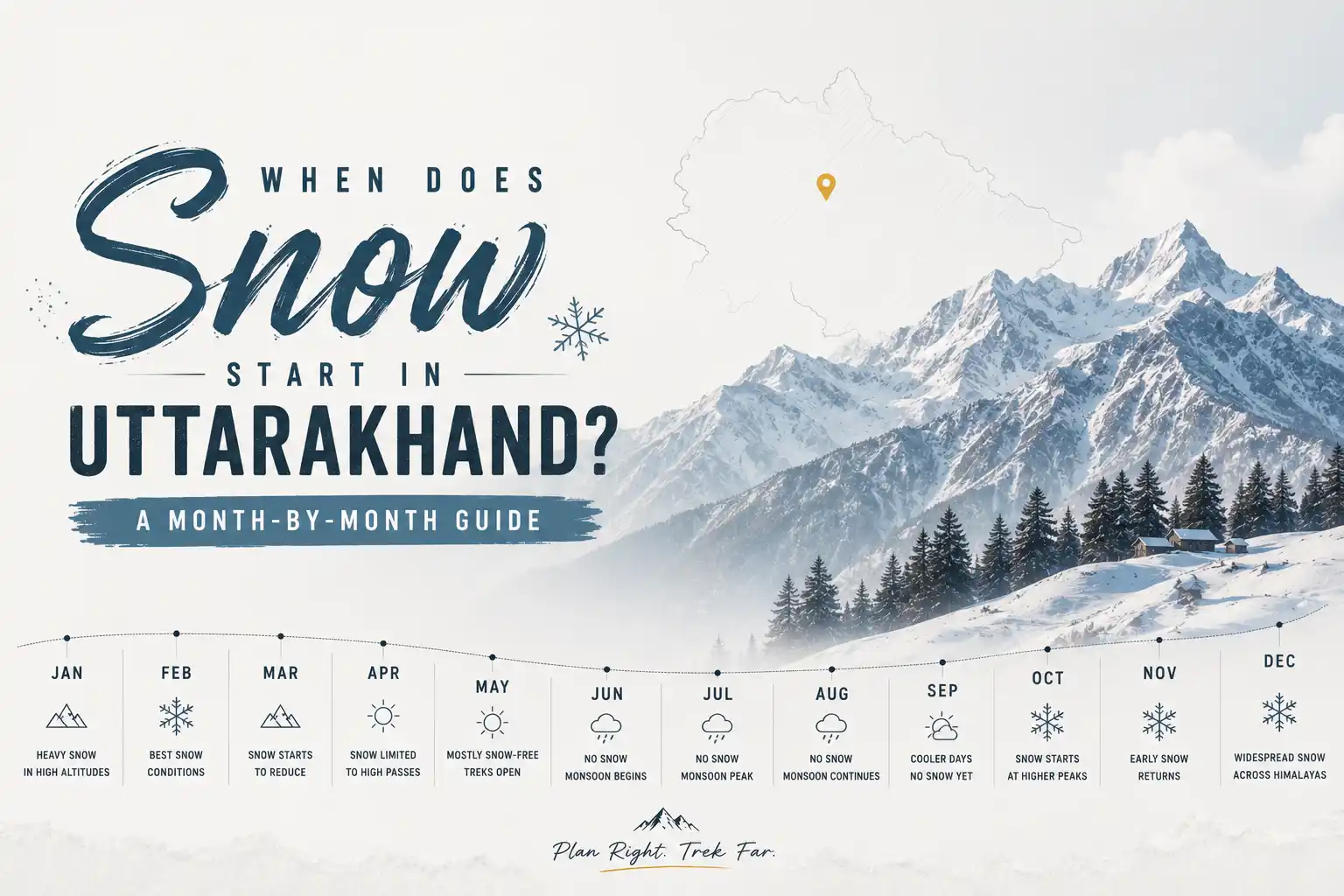
When Does Snow Start in Uttarakhand? A Month-by-Month Guide
If you’re wondering when snow starts in Uttarakhand, the short answer is: there is no single date. Snow usually arrives first in the higher Himalayan regions, while lower hill stations may have to wait until December or even January. The timing also changes from year to year depending on winter weather systems. In a normal season, higher-altitude trekking areas can begin seeing snow from November or early December, while December to February is generally the main winter-snow window across Uttarakhand.
And this is where things get interesting.
Someone planning a trip to Auli might be looking for a completely snow-covered landscape. A trekker planning Kedarkantha might actually prefer fresh snow on the trail. Someone visiting Mussoorie, meanwhile, may simply want to wake up one morning and find the town covered in white.
All three are looking for “snow in Uttarakhand”.
But the timing can be completely different.
So, when does snow start in Uttarakhand, and which places are most likely to receive it first?
Let’s break it down month by month.
When Does Snow Start in Uttarakhand?
Snow generally begins appearing in the higher reaches of Uttarakhand before it reaches the lower hill stations.
At elevations above roughly 3,000 metres, the first snowfall can arrive as early as November in some years. On Himalayan trekking routes above 10,000 feet, snowfall typically becomes more frequent around December, with January often bringing the deepest winter conditions.
Lower destinations such as Mussoorie, Nainital and Kanatal are less predictable. They need colder conditions for a longer period before snowfall reaches them.
That’s why you shouldn’t think of Uttarakhand’s snowfall season as one big switch that suddenly turns on in December.
The mountains get winter in stages.
Snowfall in Uttarakhand in November
November is when winter starts becoming noticeable in the mountains.
The higher Himalayan regions can receive their first snowfall, particularly around the upper reaches of places such as Kedarnath, Badrinath, Munsiyari and high-altitude trekking routes.
However, November is not usually the month to choose if your only goal is guaranteed snow.
You might find fresh snow at higher elevations while the lower sections of a trek remain completely dry.
That can actually make November a fascinating time for experienced trekkers.
The forests may still have autumn colours, the skies can be wonderfully clear and the higher mountains begin wearing their first layer of winter snow.
In other words, November is more about the beginning of winter than a full-blown snow season.
Snowfall in Uttarakhand in December
If you’re asking when does snow start in Uttarakhand for winter trekking, December is the month to pay attention to.
By December, snowfall becomes much more frequent in the higher reaches. Indiahikes notes that many Uttarakhand trekking routes begin receiving a good deposit of snow around early December, particularly above 10,000 feet.
This is also when popular winter treks begin transforming.
Kedarkantha, for example, is known for its winter snow, with snow cover generally developing from December onwards and lasting well into the later winter months.
Dayara Bugyal is another excellent example. Uttarakhand Tourism notes that the meadow receives heavy snow from December to March, completely changing the landscape.
By the second half of December, places such as Auli can also begin receiving more consistent snowfall, although the exact timing varies each year.
Is December a good time to see snow?
Yes, especially if you want fresh snow without necessarily dealing with the deepest part of winter.
But don’t make the mistake of assuming that every hill station in Uttarakhand will be white just because it is December.
Altitude matters.
Snowfall in Uttarakhand in January
If you want the classic Uttarakhand winter experience, January is usually your safest bet.
This is when winter is properly established across the higher mountains.
Auli, for example, generally sees some of its best snow conditions during January, while snow remains well established on high-altitude trekking routes.
This is also a fantastic period for snow treks in Uttarakhand.
Kedarkantha, Dayara Bugyal and other high-altitude routes can be covered in snow, turning forests, meadows and campsites into completely different landscapes.
But there is an important catch.
More snow also means more challenging trekking.
Fresh snowfall can make trails slower. Deep snow can hide rocks and uneven sections. Temperatures drop considerably at night, and winter weather can affect road and trail conditions.
So January may be excellent for snow lovers, but you should prepare accordingly.
Is January the Best Month for Snow in Uttarakhand?
For many travellers, January is one of the best months to experience snow in Uttarakhand, particularly at higher elevations.
However, there is no guarantee that every destination will receive heavy snowfall in a particular January.
The winter of 2025–26 is a good reminder of this. Uttarakhand experienced an unusually dry start to winter, with some higher areas not receiving their first significant snowfall until January 1–2, 2026.
So if someone tells you that snow is “100% guaranteed” on a particular date, be cautious.
The Himalayas don’t follow a calendar.
Snowfall in Uttarakhand in February
February is still very much winter in the higher mountains.
Snow remains on many trekking routes, particularly at higher elevations, even if fresh snowfall becomes less frequent in some areas.
For travellers who want snow-covered landscapes without necessarily chasing fresh snowfall every day, February can be an excellent month.
The days also begin getting longer, which can make trekking more comfortable.
On routes such as Kedarkantha and Dayara Bugyal, accumulated winter snow can continue to dominate the landscape well beyond the first snowfall of the season.
This distinction is important:
Snowfall means snow is falling from the sky.
Snow cover means the ground is already covered in snow.
You can have plenty of snow on a trek even when it hasn’t snowed for several days.
Snowfall in Uttarakhand in March
March is when things begin changing.
Lower elevations start warming up, while snow can continue to remain at higher altitudes.
This makes March something of a transition month.
Some winter trekking routes can still have substantial snow, particularly on higher sections. At the same time, lower parts of the mountains may begin showing signs of spring.
For travellers who don’t necessarily need to see active snowfall but want to walk through snow, March can still be a good option on suitable high-altitude routes.
The experience is simply different from January.
You may get longer daylight, warmer afternoons and increasingly clear mountain views alongside remaining snow.
When Does Snow Start in Uttarakhand’s Famous Destinations?
The easiest way to understand the snowfall pattern is to look at altitude.
| Destination | Typical Snow Window | What to Expect |
|---|---|---|
| Kedarkantha | December–March/April | Snow-covered trekking route |
| Dayara Bugyal | December–March | Heavy snow on the meadow |
| Auli | Late December–February | Snowfall and winter activities |
| Kanatal | December–February | Occasional snowfall |
| Chopta | Winter months | Snow at higher sections |
| Munsiyari | Winter months | Snow in town and higher areas |
| Badrinath region | Late autumn–winter | Heavy winter conditions at high altitude |
| Mussoorie | Mainly winter, highly variable | Snowfall is occasional rather than guaranteed |
| Nainital | Mainly winter, highly variable | Occasional snowfall |
These are typical seasonal patterns, not guarantees. Snowfall varies from year to year and can arrive earlier or later depending on weather systems.
When Does Snow Start on Himalayan Treks?
This is where altitude makes an enormous difference.
A trek can have completely different conditions at its base and summit.
For example, you might start walking through a forest with no snow at all. A few hours later, the trail could be covered in several centimetres of snow.
At elevations above approximately 10,000 feet, snowfall generally becomes more frequent from December, with January often bringing the heaviest winter conditions.
That’s why snow treks in Uttarakhand can remain snowy for months even though the nearest town may have no snow whatsoever.
The higher you go, the longer winter tends to stay.
Which Are the Best Snow Treks in Uttarakhand?
If you’re specifically looking for a trek where snow is an important part of the experience, several Uttarakhand routes stand out.
Kedarkantha
One of India’s most popular beginner-friendly winter treks, Kedarkantha becomes particularly attractive when its forests, campsites and summit trail are covered in snow.
Dayara Bugyal
The famous meadow receives heavy snowfall through winter, transforming its open slopes into a vast white landscape.
Brahmatal
Its higher sections can remain snow-covered during winter, making it another popular choice for trekkers looking for a classic snowy Himalayan experience.
Chopta–Chandrashila
Snow can transform the route dramatically, particularly around the higher sections towards Tungnath and Chandrashila.
Pangarchulla
For experienced trekkers looking for something considerably more demanding, winter snow adds another level of difficulty to the summit climb.
Does It Snow in Mussoorie and Nainital?
Yes, but here’s where expectations need to be realistic.
Snowfall at lower hill stations is far less predictable than snowfall at high altitude.
You can visit in winter and get cold temperatures, clear skies and absolutely no snow.
That doesn’t mean winter has failed.
It simply means the conditions weren’t right for snowfall at that elevation.
If seeing snow is the main purpose of your trip, you’re generally better off choosing a higher destination or a dedicated snow trek rather than planning an entire holiday around the possibility of snowfall in a lower hill station.
What Is the Best Month to See Snow in Uttarakhand?
If we had to simplify the entire article into one answer:
Late December to February is generally the best window for experiencing snow in Uttarakhand.
But your ideal month depends on what you want.
Want the first fresh snow?
Try December.
Want deeper, more established snow?
January is usually the strongest choice.
Want snow without the coldest part of winter?
Consider February.
Want a mixture of snow and spring-like conditions at higher elevations?
March can work.
And if you’re specifically planning a trek, the individual trail matters just as much as the month.
Fresh Snowfall vs Snow-Covered Trails: Know the Difference
This is something many first-time winter trekkers don’t realise.
You don’t need snowfall on the exact day of your trek to experience a snowy trek.
Imagine a heavy snowfall happens on Monday.
The weather clears on Tuesday.
You arrive on Wednesday.
It doesn’t snow while you’re there.
But the entire trail is still white.
That’s a snow-covered trek, even though you didn’t experience active snowfall.
In fact, many trekkers prefer this.
Fresh snowfall can make trails harder to navigate, while a settled snowpack can provide the classic winter landscape people are looking for.
So when planning your trip, don’t obsess over the question:
“Will it snow on my exact travel date?”
Instead ask:
“Will there be enough snow on the trail when I arrive?”
That’s a much more useful question.
What Should You Carry for a Snow Trek?
Once you’re heading into snowy terrain, normal trekking equipment isn’t enough.
Good waterproof trekking shoes become particularly important because wet feet can quickly become a serious problem in cold conditions.
You should also carry appropriate thermal layers, a warm jacket, gloves, a cap, sunglasses, sunscreen and proper rain/snow protection.
On snowy routes, microspikes or other traction equipment may be required depending on trail conditions.
And don’t underestimate your backpack.
Every unnecessary item becomes extra weight that you’ll have to carry through snow.
Pack smart.
Final Thoughts
So, when does snow start in Uttarakhand?
There isn’t a magic date.
The first snow can appear in the higher mountains during November, snowfall becomes increasingly common through December, and January and February generally offer the most established winter conditions. Higher-altitude trekking routes can remain snowy well beyond that, while lower destinations may receive snow only during occasional cold spells.
And that’s what makes Uttarakhand’s winter so interesting.
The mountains don’t change all at once.
Winter climbs slowly from the valleys towards the high Himalayas.
One week you’re walking through autumn forests.
A few weeks later, the same trail can disappear under snow.
And somewhere above the tree line, the mountains are already deep into winter.
If you’re planning a snow trek in Uttarakhand, don’t simply choose a month because someone told you it’s “snow season.”
Choose the right altitude, the right trek and the right expectations.
Because when the Himalayas finally turn white, you want to be there for the experience — not just for the Instagram photograph.
Planning your trip to Uttarakhand this winter season and ready to book your spot? Contact us!
Follow us on Instagram for Regular Updates!

Recent Posts



Quick booking process
+91 9557062166