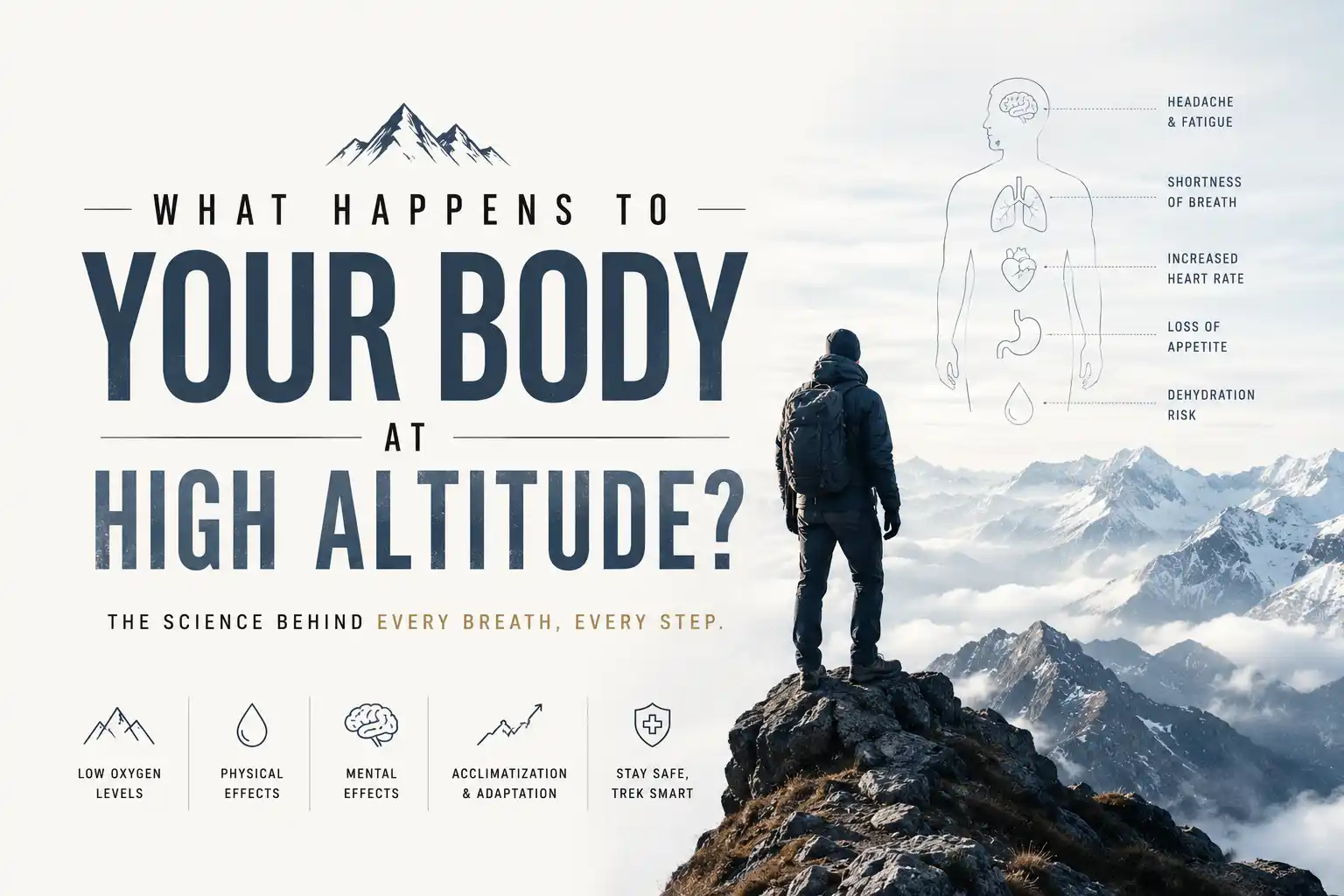
What Happens to Your Body at High Altitude?
You can be perfectly fit at sea level and still feel surprisingly weak at 3,000 or 4,000 metres. Your legs may feel heavy. Your breathing becomes faster. Your heart starts beating harder. Even climbing a gentle slope can leave you stopping for a few seconds to catch your breath. For someone experiencing a Himalayan trek for the first time, it can feel strange. Why is my body struggling when I’m not even walking that fast? The answer is altitude. As you climb higher, atmospheric pressure drops and your body has less oxygen available with every breath. Your body responds by making a series of adjustments to keep oxygen moving to your muscles and organs. Understanding what happens to your body at high altitude isn’t just interesting. It can help you recognize what is normal, what requires patience and what shouldn’t be ignored on a Himalayan trek.
Why Does High Altitude Affect the Body?
The air at high altitude isn’t actually made up of less oxygen by percentage. The difference is atmospheric pressure.
As altitude increases, the pressure decreases. This means each breath contains fewer oxygen molecules available for your body to use.
At around 2,500 metres (8,200 feet) and above, altitude-related illness becomes a possibility, particularly when someone ascends too quickly without acclimatizing.
That’s why a person who has no problem walking several kilometres at home can suddenly find themselves breathing heavily on a Himalayan trail.
Your body simply has to work harder.
Your Breathing Gets Faster
One of the first things you’ll notice at high altitude is your breathing.
Even at a slow walking pace, you may feel like you need to take deeper or more frequent breaths. This is your body’s natural response to lower oxygen availability.
Instead of trying to maintain your normal walking speed, most trekkers need to slow down.
This is especially noticeable on demanding routes such as Pangarchulla, Roopkund and Bali Pass, where you spend considerable time at high elevations.
A slower pace isn’t a sign that you’re unfit.
Sometimes, slow is exactly what your body needs.
Your Heart Works Harder
Your heart also has to compensate for the reduced oxygen available at altitude.
It increases blood circulation so oxygen can be delivered to your muscles and other organs more efficiently. As a result, your heart rate can feel noticeably higher than it would at the same walking pace at sea level.
This is why altitude can make an ordinary climb feel much harder than expected.
You might be walking slowly, but your body is working overtime.
Your Body Starts Adapting
This is where acclimatization comes in.
Your body doesn’t simply give up because there is less oxygen. It begins adapting.
Breathing changes, circulation adjusts and, over time, your body increases its ability to transport oxygen. These changes don’t happen instantly, which is why gradual ascent is one of the most important parts of high-altitude trekking.
The CDC recommends ascending gradually and allowing time for the body to adjust, particularly once you are above about 2,750 metres.
That’s why responsible Himalayan trekking itineraries don’t treat altitude like a race.
You climb.
You rest.
You allow your body to catch up.
Why Do You Feel Tired at High Altitude?
Fatigue is one of the most noticeable effects of high altitude.
Your muscles are receiving oxygen under conditions that are different from what they’re used to at sea level. Add several hours of walking, uneven terrain, a heavy backpack and cold weather, and the physical demand becomes even greater.
This is why a trekker can feel exhausted after covering a distance that would normally seem easy.
It doesn’t necessarily mean you’re not fit.
Altitude changes the rules.
Why Is Sleeping Difficult at High Altitude?
Interestingly, your body doesn’t stop adjusting when you reach camp.
Sleep can also become difficult.
Some trekkers experience lighter sleep or wake up several times during the night. Changes in breathing during sleep are common at altitude, so your first few nights in a high-altitude campsite may feel very different from sleeping at home.
You may be physically exhausted but still wake up feeling like you haven’t slept properly.
This is one reason rest days and sensible acclimatization are important on longer Himalayan treks.
What Happens to Your Appetite?
Altitude can affect your appetite too.
Some trekkers feel less hungry, while others experience nausea or simply don’t feel like eating after a long day on the trail.
That’s not ideal because trekking requires plenty of energy.
Even if you’re not particularly hungry, try to eat regular meals and snacks. Your body still needs fuel to deal with long hours of walking and cold temperatures.
Staying hydrated is equally important. The dry mountain air and increased breathing can contribute to fluid loss, while the cold may make you less aware of thirst.
What Is Altitude Sickness?
This is where trekkers need to pay attention.
Acute Mountain Sickness (AMS) is the most common form of altitude illness. Symptoms can include headache, tiredness, nausea, loss of appetite, dizziness and vomiting.
Mild symptoms can occur as your body adjusts, but they should not simply be ignored.
The most important rule is:
Don’t keep climbing if you’re getting worse.
If symptoms become severe, particularly if someone develops confusion, loss of coordination, severe breathlessness or extreme weakness, the situation can become dangerous. Serious altitude illnesses such as HACE and HAPE require immediate descent and medical attention.
Altitude sickness isn’t something you should try to “push through” just because you’re determined to finish a trek.
Can Fit People Get Altitude Sickness?
Yes.
This is probably one of the biggest misconceptions about high-altitude trekking.
Being physically fit definitely helps. Strong legs, good cardiovascular fitness and regular training can make the physical demands of a Himalayan trek much easier.
But fitness doesn’t automatically mean you’re acclimatized.
Someone who runs every day can still experience altitude sickness if they ascend too quickly.
That’s because fitness and acclimatization are two different things.
You can train your body before a trek.
You cannot train your body to instantly adapt to altitude.
How Can You Prepare Your Body for High Altitude?
The best preparation starts before you reach the mountains.
Build your endurance with regular walking, running, cycling or stair climbing. Strengthen your legs and core, especially if you’re preparing for a demanding trek such as Pangarchulla or Bali Pass.
Once you’re on the mountain, however, preparation changes.
Walk at a comfortable pace. Drink regularly. Eat properly and get enough rest.
Most importantly, give your body time to acclimatize.
Gradual ascent is one of the most effective ways to reduce the risk of altitude illness.
And if you develop worsening symptoms, tell your trek leader instead of trying to hide them.
Does Everyone React to High Altitude the Same Way?
No.
Two people following exactly the same trekking itinerary can have completely different experiences.
One person might sleep normally and feel energetic, while another could develop a headache and feel exhausted.
Previous trekking experience doesn’t guarantee that you’ll react the same way on your next trip either.
That’s why there is no perfect formula for predicting how your body will respond.
The safest approach is to respect the altitude rather than assume your body will handle it automatically.
Final Thoughts
One of the most fascinating parts of Himalayan trekking is that the mountain starts changing your experience long before you reach the summit.
Your breathing changes.
Your heart works harder.
Your sleep may become lighter.
Your appetite can disappear.
And slowly, your body begins adapting to an environment where oxygen is less readily available.
That’s what makes high-altitude trekking so different from an ordinary hike.
Whether you’re preparing for Pangarchulla, Roopkund, Bali Pass, Valley of Flowers or another Himalayan trek, remember that fitness is only one part of the equation.
You can train for the trail. But you have to acclimatize to the altitude.
Give your body time, listen to what it’s telling you and don’t treat the mountain like a race.
The summit will still be there.
Now that you know how to take care of your body at high altitudes, and are ready to book your spot, Contact us!
Follow us on Instagram for Regular Updates!

Recent Posts

Is Gulabi Kantha Trek Worth It? An Honest Guide for 2026

Is Kedarkantha Difficult for Beginners? An Honest 2026 Guide
Quick booking process
+91 9557062166