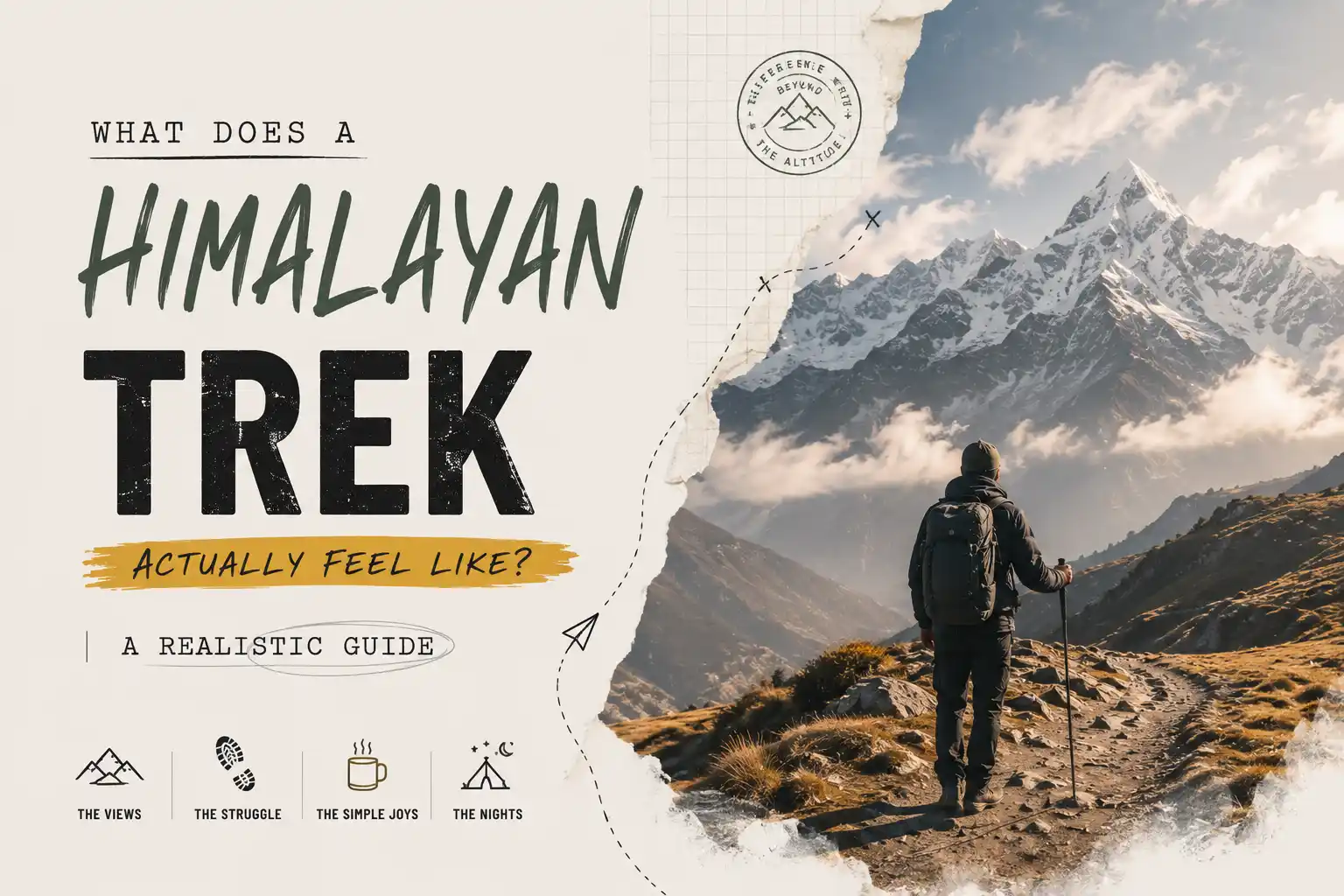
What Does a Himalayan Trek Actually Feel Like? A Realistic Guide
What does a Himalayan trek actually feel like? It feels exciting, exhausting, peaceful and rewarding, often within the same day. You wake up before sunrise, put on cold trekking shoes, walk uphill until your legs start complaining, and then suddenly find yourself standing in front of a massive Himalayan peak. That contrast is what makes a Himalayan trek so memorable.
Photos usually show the best parts: snow-covered trails, beautiful campsites and dramatic summit views. They rarely show the tired legs, sweaty layers, cold fingers or the moment you wonder, “Why did I sign up for this?”
Then you see the mountains again.
And you remember why.
What Does a Himalayan Trek Feel Like on the First Day?
The first day usually feels easier than expected.
Excitement keeps you moving. Your backpack still feels manageable, everyone is taking photographs, and the trail looks beautiful. Then the climbing begins.
Your breathing gets heavier. The legs start working harder. Before long, you realise that trekking isn’t about walking fast. It’s about walking for several hours without burning yourself out.
A steady pace makes a huge difference. Shorter steps, regular breathing and small breaks help you conserve energy for the rest of the day.
By evening, you’ll probably be tired. Still, reaching your first campsite brings a satisfying feeling: you made it through your first day in the mountains.
The Physical Reality of a Himalayan Trek
A Himalayan trek is physically demanding, although the difficulty depends heavily on the route.
Nag Tibba feels very different from Pangarchulla. Kedarkantha isn’t the same challenge as Roopkund. Even on one trek, some days can feel much harder than others.
Expect plenty of uphill walking, descents and uneven terrain. Rocks, roots, mud and snow can all become part of the trail depending on the season.
Your calves might hurt. Your shoulders may ache from the backpack. After a long day, your feet will definitely want a break.
That’s normal.
You don’t need to avoid every bit of discomfort. The goal is to prepare well enough that the physical effort remains manageable.
What Does High Altitude Feel Like?
Altitude is one of the biggest differences between a regular hike and a high-altitude Himalayan trek.
As you climb higher, your body has to work harder. A slope that seems easy at lower elevation can suddenly leave you breathing heavily.
You may find yourself stopping more often. That’s not a sign of poor fitness. Your body simply needs time to adjust.
Pacing, hydration and proper acclimatization become increasingly important as altitude increases. Most importantly, don’t ignore unusual or worsening symptoms.
Even very fit people can struggle with altitude.
The Strange Thing About Trekking: You Get Tired and Happy Together
This is one of the hardest parts of the Himalayan trek experience to explain.
Imagine walking uphill for several hours. Your legs are tired, you’re hungry and the campsite still seems far away.
Then the trees open.
A massive mountain appears in front of you.
Everyone stops.
For a few seconds, nobody says anything.
You might still be exhausted, but you’re smiling.
That’s the magic of trekking. The difficult moments make the beautiful ones feel even better.
What Does a Himalayan Trek Feel Like at Camp?
Arriving at camp is one of the best parts of the day.
The backpack comes off. Your shoes come off. Someone offers you a hot cup of tea.
Suddenly, everything feels better.
Evening at a Himalayan campsite has its own rhythm. People talk about the day’s climb, guides explain the next day’s route, and trekkers who arrived as strangers start becoming friends.
There is no rush to go anywhere.
You eat, talk, watch the mountains and eventually crawl into your sleeping bag.
For a few hours, everyday life feels very far away.
What Does Trekking in Snow Feel Like?
Snow completely changes the experience.
Your steps become slower and more deliberate. Uneven ground becomes harder to see, and steep sections require extra attention.
Yet the scenery becomes spectacular.
Pine forests turn white. Campsites look completely different. Every footprint becomes part of the trail.
On winter treks such as Kedarkantha, Dayara Bugyal and Pangarchulla, snow can turn the journey into a completely different adventure.
Just remember that beautiful snow comes with extra effort. Cold temperatures, slippery sections and deeper snow can make a trek considerably more demanding.
What Does a Himalayan Trek Do to Your Mind?
This might be the biggest surprise for first-time trekkers.
After a couple of days, your priorities become incredibly simple.
Where is the next water point?
How far is lunch?
Is that the campsite?
Did someone see my gloves?
Can I get another cup of tea?
Back home, your mind is usually juggling dozens of things. On a Himalayan trek, your attention narrows down to the trail in front of you.
Walk.
Eat.
Rest.
Sleep.
Then you do it again.
That simplicity can feel surprisingly refreshing.
What Happens When the Trek Gets Difficult?
Every trek has a difficult moment.
Perhaps it’s a steep climb. Maybe your feet hurt, the weather changes or the campsite seems much farther away than expected.
This is where mental strength becomes important.
Instead of thinking about the entire route, focus on smaller targets. Reach the next bend. Then the next ridge. Take a break. Continue towards lunch.
Breaking a difficult day into smaller sections makes the challenge feel much more manageable.
A Himalayan trek teaches you something valuable here: you don’t always need to think about the finish line. Sometimes you simply need to take the next step.
What Does Reaching the Summit Feel Like?
There isn’t one universal reaction.
Some people celebrate.
Some cry.
Others are simply too tired to say anything.
After hours of climbing, reaching the summit can feel almost surreal. You turn around and see mountains stretching across the horizon. Then you realise how far you’ve walked.
The exhaustion slowly turns into pride.
That’s why a summit isn’t just about the photograph.
You earned that view.
The Descent Is Part of the Experience Too
Here’s something first-time trekkers often underestimate: downhill sections can hurt.
Your legs are already tired, and every step puts pressure on your knees. Loose rocks and uneven ground can make the descent surprisingly tiring.
Still, there’s a comforting feeling that comes with going downhill.
The altitude is dropping. The trail becomes familiar. You know the trek is slowly coming to an end.
And when you finally reach the road, something strange happens.
You start missing the mountains.
What You’ll Actually Remember After a Himalayan Trek
Years later, you may not remember every kilometre you walked.
Instead, you’ll remember the little things.
The person who shared their chocolate.
The guide who kept saying, “Bas thoda aur.”
The sunrise everyone woke up early to see.
That terrible joke at dinner.
The cup of tea after a long climb.
The silence inside a Himalayan forest.
The night sky above your campsite.
Those moments become the real Himalayan trekking experience.
So, What Does a Himalayan Trek Actually Feel Like?
It feels harder than the photographs suggest.
It can be cold, tiring and uncomfortable. Some climbs will test your patience, and there may be moments when you seriously question your decision to come.
Yet the experience gives something back.
A simple meal tastes better. A warm sleeping bag feels luxurious. A sunrise becomes an event. A mountain view becomes a memory.
That’s what a Himalayan trek actually feels like.
It isn’t a comfortable holiday, and it isn’t a race to collect summit photographs. Instead, it’s a few days of slowing down, living simply and discovering how little you actually need to feel happy.
You walk, you struggle, you laugh, you rest.
Then you keep walking.
And somewhere along the trail, the journey becomes more important than the destination.
Planning your Trek this and ready to book your spot? Contact us!
Follow us on Instagram for Regular Updates!

Recent Posts
Quick booking process
+91 9557062166