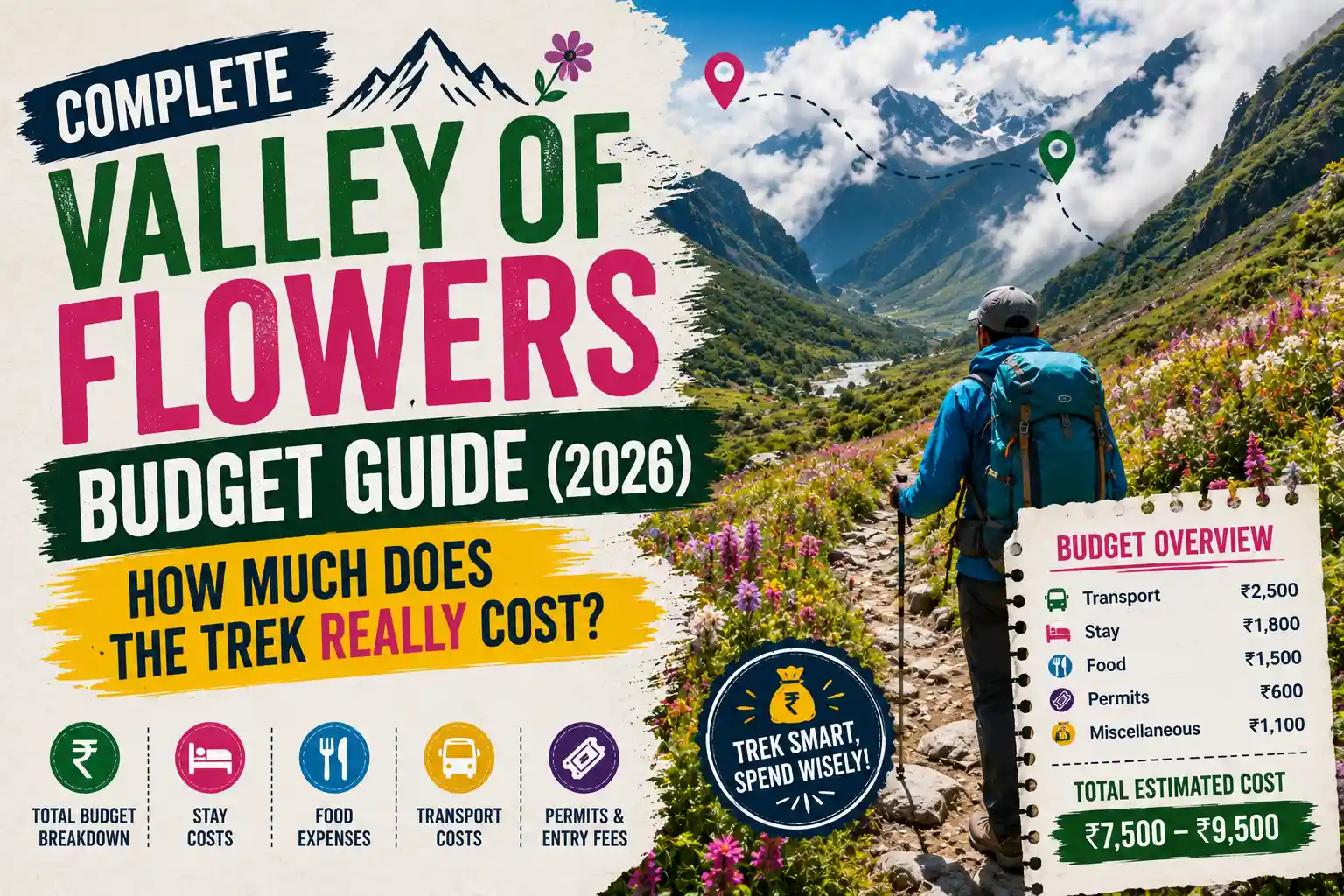
Complete Valley of Flowers Budget Guide (2026): How Much Does the Trek Really Cost?
Every year, thousands of travelers dream of visiting the Valley of Flowers. They see photographs of colorful alpine meadows, mist-covered mountains, wooden bridges crossing glacial streams, and endless stretches of wildflowers blooming beneath the Himalayas. It looks like something out of a postcard. Then comes the practical question. How much does the Valley of Flowers Trek actually cost? The internet is full of conflicting answers. Some articles claim you can do it for under ₹5,000, while others suggest budgets of ₹20,000 or more. The truth lies somewhere in between and depends entirely on how you travel. This Valley of Flowers Budget Guide (2026) breaks down every major expense, from transportation and accommodation to permits, food, and optional costs. Whether you’re planning a budget backpacking trip or a comfortable Himalayan vacation, this guide will help you estimate your expenses realistically.
Understanding the Valley of Flowers Trek Cost
Before discussing numbers, it’s important to understand that the Valley of Flowers is not a destination where you simply drive up, take photographs, and return.
The journey involves:
- Traveling to Govindghat
- A trek to Ghangaria
- Entry permits
- Accommodation in remote mountain locations
- Food expenses
- Optional visit to Hemkund Sahib
Because the valley is located inside a protected national park in the Himalayas, costs are naturally higher than a regular hill station trip.
However, compared to many other Himalayan adventures, the Valley of Flowers Trek remains surprisingly affordable.
Typical Valley of Flowers Budget in 2026
For most travelers, the total cost generally falls into one of these categories:
| Travel Style | Approximate Budget |
|---|---|
| Budget Backpacker | ₹7,000 – ₹10,000 |
| Comfortable Self-Planned Trip | ₹12,000 – ₹18,000 |
| Organized Trek Package | ₹10,000 – ₹18,000 |
| Premium Experience | ₹20,000+ |
The exact amount depends largely on where you’re traveling from and how comfortably you prefer to travel.
Transportation Costs
Transportation usually accounts for the largest portion of your Valley of Flowers budget.
Most travelers begin from either Haridwar, Rishikesh, or Dehradun.
The route generally looks like this:
Haridwar → Joshimath → Govindghat → Ghangaria → Valley of Flowers
Delhi to Haridwar
- Train: ₹300 – ₹1,500
- Volvo Bus: ₹700 – ₹1,500
- Flight to Dehradun: ₹3,000 – ₹8,000
Haridwar to Govindghat
Shared taxis and buses operate throughout the season.
Expected cost:
- Bus: ₹700 – ₹1,000
- Shared taxi: ₹1,000 – ₹1,500
- Private taxi: ₹6,000 – ₹10,000
Most budget travelers prefer shared transport because it significantly reduces expenses.
Valley of Flowers Entry Fee (2026)
One expense many travelers forget while calculating their Valley of Flowers budget is the national park entry fee.
As of recent seasons, the Valley of Flowers National Park charges separate fees for Indian and foreign visitors.
For Indian nationals:
- Approximately ₹200–₹250 per person
For foreign nationals:
- Higher charges apply.
Visitors should always verify the latest fees before traveling because government rates can change.
Compared to the overall trip cost, the entry permit is relatively inexpensive.
Accommodation Costs
Accommodation can have a major impact on your overall Valley of Flowers budget.
Staying in Govindghat
Most travelers spend a night here before beginning the trek.
Budget hotels:
₹800 – ₹1,500 per night
Comfortable hotels:
₹2,000 – ₹4,000 per night
Staying in Ghangaria
Ghangaria serves as the base camp for both Valley of Flowers and Hemkund Sahib.
Since everything has to be transported to this remote location, accommodation prices are naturally higher.
Budget guesthouses:
₹1,000 – ₹1,800
Standard hotels:
₹2,000 – ₹4,000
Premium options:
₹4,000+
During peak bloom season in August, rates often increase due to high demand.
Booking in advance is highly recommended.
Food Expenses
Food in mountain regions is generally more expensive than in cities because supplies must be transported over long distances.
However, meals remain reasonably affordable.
Average meal costs:
- Breakfast: ₹100 – ₹250
- Lunch: ₹150 – ₹300
- Dinner: ₹200 – ₹350
- Tea and snacks: ₹20 – ₹100
For a typical 4-5 day trip, most travelers spend around ₹1,500 – ₹3,000 on food.
Trekking Expenses
The trek itself does not require expensive gear if you already own basic trekking equipment.
However, some first-time trekkers may need to purchase:
- Trekking shoes
- Rain jacket
- Backpack cover
- Quick-dry clothing
- Trekking poles
If you’re buying everything from scratch, gear expenses can easily exceed the actual Valley of Flowers Trek cost.
Fortunately, most items can be reused for future adventures.
Should You Hire a Mule or Porter?
The trek from Govindghat to Ghangaria covers approximately 13 kilometers.
Many travelers complete it comfortably on foot.
However, elderly pilgrims and travelers carrying heavy luggage sometimes choose:
- Mules
- Porters
- Helicopter services (season dependent)
These optional services can add significantly to your Valley of Flowers budget.
For healthy travelers with moderate fitness, walking remains the most economical and rewarding option.
Hemkund Sahib: Additional Budget Considerations
Most visitors combine Valley of Flowers with Hemkund Sahib.
This adds another trekking day but doesn’t significantly increase the overall budget.
Additional expenses generally include:
- Food
- Accommodation
- Personal purchases
Since you’re already staying in Ghangaria, visiting Hemkund Sahib is usually a cost-effective addition.
Budget vs Trek Package: Which Is Better?
One of the most common questions people ask while reading a Valley of Flowers Budget Guide is whether they should plan independently or book a package.
Self-Planned Trip
Pros:
- Flexible itinerary
- Potentially cheaper
- Greater freedom
Cons:
- More planning required
- Transportation coordination
- Accommodation management
Organized Trek Package
Pros:
- Everything arranged
- Less logistical stress
- Suitable for first-time travelers
Cons:
- Less flexibility
- Slightly higher upfront cost
Many reputable operators offer Valley of Flowers packages between ₹10,000 and ₹18,000 depending on inclusions.
For first-time Himalayan travelers, packages often provide better value than expected.
Hidden Costs Most Travelers Forget
A good Valley of Flowers Budget Guide should also account for smaller expenses that add up during the trip.
These include:
- Mobile charging fees
- Bottled water
- Snacks
- Extra tea and coffee stops
- Rain ponchos
- Souvenirs
- Emergency transportation
While none of these are expensive individually, together they can increase your trip cost by ₹1,000–₹2,000.
It’s always wise to keep a buffer amount.
How to Reduce Your Valley of Flowers Budget
If you’re traveling on a limited budget, several simple decisions can lower costs significantly.
Travel during weekdays instead of peak weekends.
Book accommodation early.
Use shared transport whenever possible.
Carry your own water bottle and reusable essentials.
Avoid last-minute bookings during peak bloom season.
Most importantly, focus on experiences rather than luxury upgrades.
The beauty of the valley remains the same regardless of where you stay.
Is the Valley of Flowers Trek Worth the Cost?
After calculating transportation, accommodation, permits, and food, some travelers wonder whether the expense is justified.
The answer becomes obvious the moment you enter the valley.
Few places in India offer the combination of natural beauty, biodiversity, mountain scenery, waterfalls, and trekking experience found here.
This is not simply a tourist attraction.
It is one of the most extraordinary landscapes in the Himalayas.
For many travelers, the Valley of Flowers becomes a once-in-a-lifetime memory.
Viewed from that perspective, the cost feels remarkably reasonable.
Final Thoughts
A realistic Valley of Flowers budget in 2026 for most travelers falls between ₹10,000 and ₹18,000, depending on travel style and comfort preferences.
Budget travelers can spend less, while those seeking additional comfort may spend more.
The key takeaway is that this trek is far more accessible than many people assume.
With a little planning, careful budgeting, and advance bookings, the Valley of Flowers can be experienced without stretching your finances.
And when you finally stand among those endless Himalayan meadows covered in flowers, you’ll probably agree that every rupee was well spent.
Planning your VOF Trek and ready to book your spot? Contact us!
Follow us on Instagram for Regular Updates!

Recent Posts
Is Gulabi Kantha Trek Worth It? An Honest Guide for 2026

Is Kedarkantha Difficult for Beginners? An Honest 2026 Guide
Quick booking process
+91 9557062166