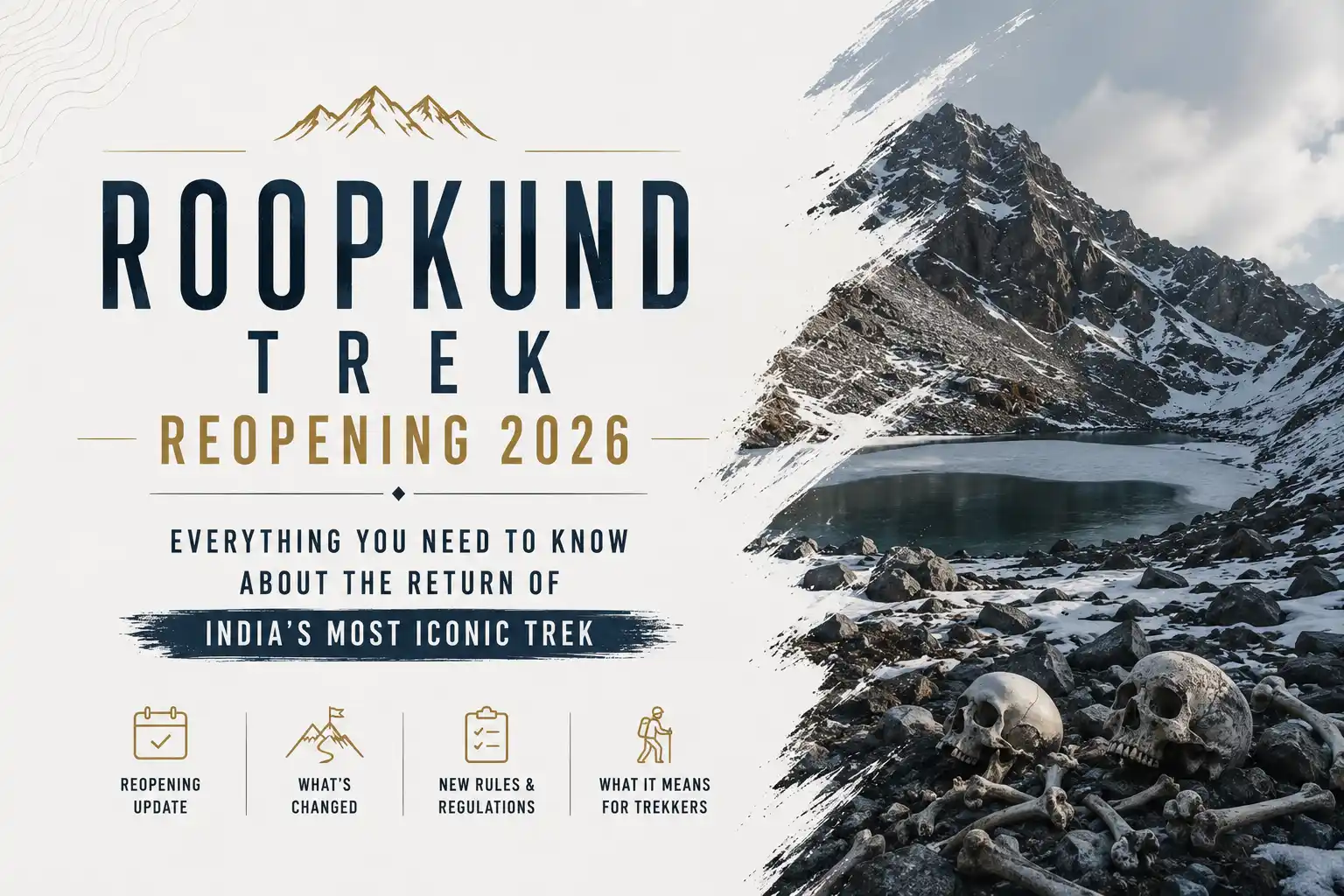
Roopkund Trek Reopening 2026: Everything You Need to Know About the Return of India’s Most Iconic Trek
“Wait… Roopkund is open again?” That single question has echoed across trekking communities ever since news of the Roopkund Trek reopening began circulating.
For years, Roopkund was more than just another Himalayan trek. It was a rite of passage for trekkers across India. The mysterious Skeleton Lake, the dramatic ridgelines of Ali and Bedni Bugyal, the towering views of Trishul and Nanda Ghunti, and the thrill of standing beside one of the world’s most fascinating archaeological sites made it one of the country’s most sought-after trekking destinations.
Then, almost overnight, it disappeared.
The 2018 restrictions on camping in Uttarakhand’s alpine meadows brought the classic Roopkund Trek to a halt. Thousands of trekkers who had dreamed of visiting Skeleton Lake were left wondering if the trail would ever reopen.
Now, after years of uncertainty, there is finally encouraging news.
Recent developments following the Supreme Court’s July 2026 order have removed some of the key restrictions that prevented the trek from operating, and trekking organizations have already begun announcing Roopkund departures for the coming season.
So, is the Roopkund Trek reopening? What exactly has changed? And what does it mean for trekkers planning a Himalayan adventure in 2026?
Let’s look at everything you need to know.
Why Was the Roopkund Trek Closed?
To understand the excitement surrounding the Roopkund Trek reopening, it’s important to know why the trek disappeared in the first place.
In 2018, the Uttarakhand High Court passed directions aimed at protecting the fragile alpine meadows, locally known as bugyals.
These meadows are among the most delicate ecosystems in the Himalayas. During the trekking season, increasing visitor numbers, camping, waste generation, and environmental degradation had become major concerns.
As part of the court’s directions, overnight camping in bugyals was prohibited, along with several other conservation measures.
Although the intention was environmental protection, the impact on Roopkund was immediate.
Since the traditional trek relied on camping at high-altitude locations like Bedni Bugyal and Bhagwabasa, operating the classic route became practically impossible.
For many trekkers, it felt like the end of an era.
What Changed in 2026?
After years of legal proceedings, a major development arrived in July 2026.
The Supreme Court heard the matter related to the 2018 restrictions and modified certain directions that had significantly affected Himalayan trekking.
According to the order communicated by the Divisional Forest Officer (Badrinath Forest Division):
- The blanket restriction on overnight stays in bugyals has been modified.
- Visitor numbers continue to remain regulated to protect the alpine ecosystem.
- Conservation measures remain in place, ensuring trekking activities continue responsibly.
This doesn’t mean unrestricted tourism has returned.
Instead, it creates a balanced approach where trekking can resume while environmental protection remains the priority.
For trekking enthusiasts, this is the most significant update in years.
Why the Roopkund Trek Matters
There are beautiful Himalayan treks.
Then there’s Roopkund.
Few trekking destinations in India combine history, mythology, archaeology, adventure, and breathtaking mountain landscapes quite like this one.
Hidden at an altitude of nearly 16,500 feet (5,029 metres) lies Roopkund Lake, famously known as Skeleton Lake.
Hundreds of ancient human skeletal remains found around the frozen lake have fascinated scientists, historians, and explorers for decades.
Modern DNA studies have revealed that the remains belonged to multiple groups of people from different periods and even different parts of the world, making Roopkund one of the most intriguing archaeological sites in the Himalayas.
For trekkers, reaching the lake has always been about far more than simply completing another mountain trail.
It’s about walking into a place filled with mystery.
More Than Just Skeleton Lake
While Skeleton Lake often grabs all the attention, experienced trekkers know that Roopkund’s real beauty begins long before reaching the lake itself.
The journey passes through some of Uttarakhand’s most spectacular landscapes.
Ali Bugyal and Bedni Bugyal are widely regarded as two of India’s finest alpine meadows. During summer, these vast rolling grasslands stretch endlessly beneath towering Himalayan peaks.
Ancient oak and rhododendron forests gradually give way to open ridgelines, where every turn reveals another breathtaking mountain panorama.
On clear days, trekkers are rewarded with magnificent views of Trishul, Nanda Ghunti, Chaukhamba, Neelkanth, and many other iconic Himalayan peaks.
The scenery constantly changes, making every day of the trek feel unique.
What Can Trekkers Expect After the Reopening?
Although the Roopkund Trek reopening is exciting news, the experience may differ slightly from what trekkers remember before 2018.
Environmental conservation remains the top priority.
Visitor numbers are expected to remain controlled.
Forest permissions, responsible trekking practices, and strict waste management protocols will continue to play an important role.
Trekkers should also expect operators to follow updated guidelines issued by the Forest Department.
In many ways, that’s a positive change.
A more regulated trekking experience helps preserve Roopkund for future generations while also reducing overcrowding during the trekking season.
Will It Be Difficult to Get a Slot?
Very likely.
Roopkund has spent several years on almost every trekker’s bucket list.
Many people postponed their plans after the restrictions came into effect, hoping the trail would eventually reopen.
Now that trekking appears to be returning, demand is expected to be exceptionally high.
Limited visitor numbers could make available slots fill much faster than before.
If you’re considering the Roopkund Trek in 2026, booking early will probably be one of the smartest decisions you can make.
Is This the Right Time to Experience Roopkund?
For many trekkers, absolutely.
The excitement surrounding the Roopkund Trek reopening isn’t simply about another trail becoming accessible again.
It’s about the return of one of India’s most iconic Himalayan adventures.
For nearly a decade, Roopkund existed only through old photographs, travel documentaries, and stories shared by those fortunate enough to complete it before the restrictions.
Now, a new generation of trekkers finally has the opportunity to experience it for themselves.
Responsible Trekking Matters More Than Ever
The reopening also comes with responsibility.
The fragile bugyals of Uttarakhand aren’t just beautiful landscapes—they are sensitive ecosystems that take decades to recover from damage.
Simple actions such as carrying reusable water bottles, avoiding littering, respecting campsite guidelines, and staying on designated trails make a significant difference.
Every trekker who visits Roopkund now becomes part of its future.
Protecting the mountains is just as important as exploring them.
Should You Choose Roopkund in 2026?
If you’ve always dreamed of combining adventure, mystery, history, and world-class Himalayan scenery into one unforgettable journey, few treks come close.
Roopkund offers everything that makes trekking in the Himalayas so special.
Ancient forests.
Endless alpine meadows.
High mountain passes.
Legendary Himalayan peaks.
And finally, one of the world’s most mysterious lakes waiting high above the clouds.
The return of this iconic trail is more than just another trekking update.
It’s the return of a Himalayan legend.
Final Thoughts
The Roopkund Trek reopening marks one of the biggest developments in Indian trekking in recent years.
After years of uncertainty following the 2018 restrictions, the legal changes introduced in 2026 have renewed hope that one of India’s most celebrated trekking routes is making its return.
While conservation remains central to the future of the trail, the possibility of once again walking through Ali Bugyal, crossing Bedni Bugyal, climbing towards Skeleton Lake, and witnessing the magnificent Trishul massif is something countless trekkers have been waiting for.
If Roopkund has always been on your bucket list, 2026 could be the year that dream finally becomes reality.
The mountains have waited.
Now, it might just be your turn.
Planning the Roopkund Trek and ready to book your spot? Contact us!
Follow us on Instagram for Regular Updates!

Recent Posts

Is Gulabi Kantha Trek Worth It? An Honest Guide for 2026


Is Kedarkantha Difficult for Beginners? An Honest 2026 Guide
Quick booking process
+91 9557062166