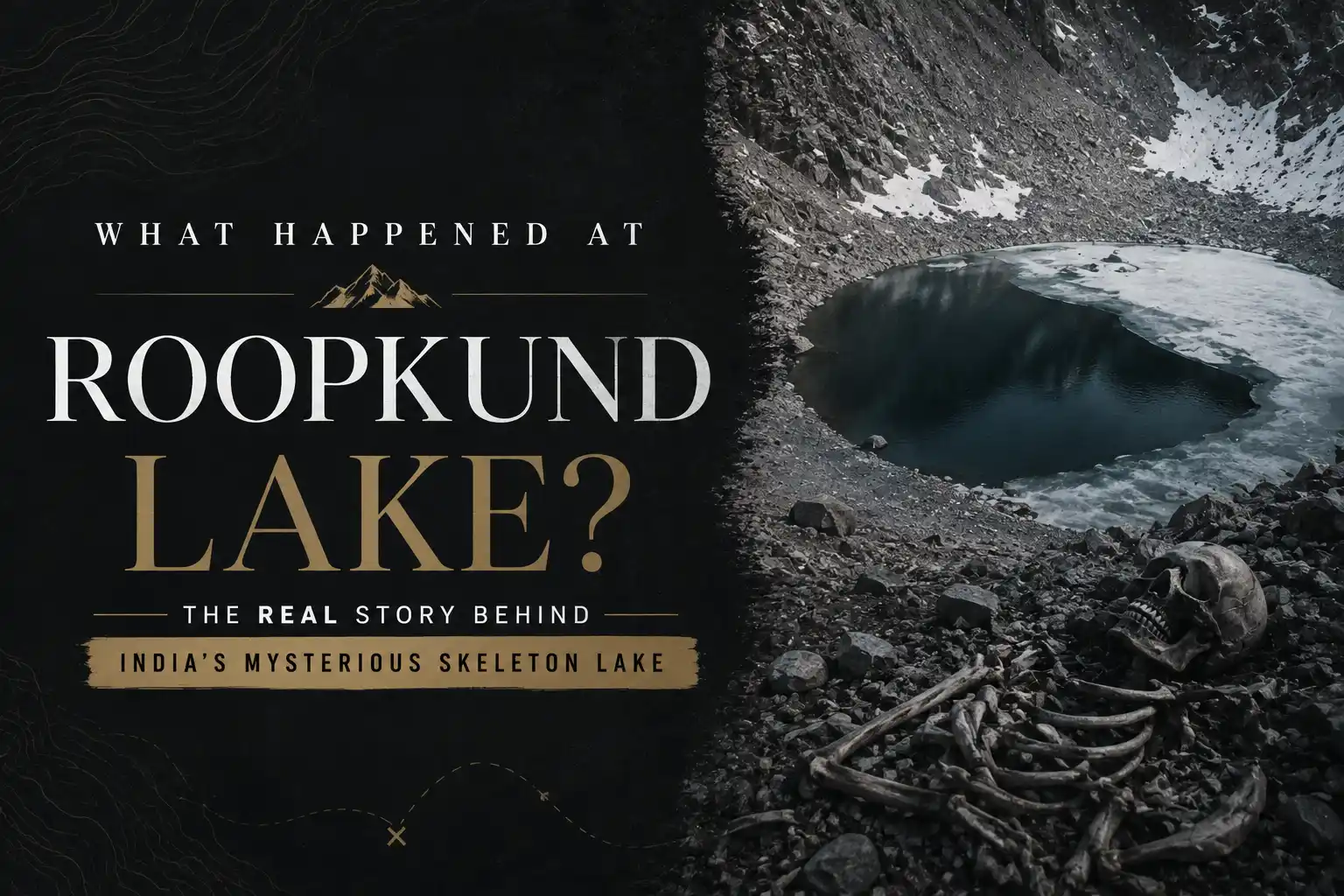
What Happened at Roopkund Lake? The Real Story Behind India’s Mysterious Skeleton Lake
You have been trekking for two days through the untouched meadows of Ali Bugyal and Bedni Bugyal. Towering Himalayan peaks surround you, the air is thin, and every step brings you closer to one of India’s most mysterious places. Finally, after a steep climb through rocky terrain, you reach a small glacial lake sitting quietly at an altitude of nearly 16,500 feet. At first glance, it looks ordinary. Crystal-clear water. Snow-covered ridges. Silence. Then something catches your eye. A human skull. You assume it’s a trick of the light. But as you walk closer, another skull appears. Then another. Scattered around the edge of the lake are human bones, rib cages, femurs, and skulls that have remained frozen in time for centuries. You’re standing beside Roopkund Lake, better known across the world as Skeleton Lake. For decades, this remote Himalayan lake has puzzled historians, archaeologists, scientists, and trekkers alike. Who were these people? How did they die? Why were hundreds of skeletons lying beside a tiny lake more than 5,000 metres above sea level? Some believed it was an ancient battle. Others blamed an epidemic. Local legends spoke of divine punishment. And then, modern science stepped in. What researchers discovered changed almost everything we thought we knew about the Roopkund Skeleton Mystery.
The Discovery That Shocked the World
Although local shepherds were aware of the lake long before outsiders arrived, the mystery gained international attention in 1942.
That year, a British forest ranger named H.K. Madhwal reported seeing hundreds of human skeletons around the frozen lake during one of his patrols in the Chamoli district of Uttarakhand.
At the time, the world was in the middle of the Second World War.
Naturally, British authorities feared the worst.
Some officials suspected that these remains belonged to Japanese soldiers attempting to cross the Himalayas into India after advancing through Burma.
An investigation soon ruled out that possibility.
The skeletons were far older than anyone had imagined.
Instead of solving the mystery, the discovery only raised more questions.
Who were these people?
Why had they travelled to such an isolated place?
And what could possibly have killed an entire group at this altitude?
Those questions would remain unanswered for decades.
Why Is Roopkund Called Skeleton Lake?
Unlike many archaeological sites where human remains are carefully buried beneath layers of soil, the skeletons at Roopkund were lying out in the open.
During summer, when the snow melted, bones became clearly visible around the edge of the lake. In some years, visitors could even see complete skeletons preserved remarkably well by the cold Himalayan climate.
Researchers eventually estimated that the lake contained the remains of several hundred individuals.
Some skeletons still had hair attached.
Others retained pieces of leather footwear, wooden artefacts, jewellery, bamboo sticks, and fragments of clothing.
The freezing temperatures had slowed decomposition so effectively that many remains survived for centuries.
It looked less like an archaeological site and more like time itself had stopped.
That unusual sight earned Roopkund its now-famous nickname:
Skeleton Lake.
The First Theory: Did Everyone Die in One Catastrophic Event?
For many years, scientists believed all the skeletons belonged to a single group.
After all, finding hundreds of bodies in one location naturally suggests one tragic event.
But what kind of disaster could kill so many people in the middle of the Himalayas?
Several theories emerged.
Some historians believed they were soldiers.
Others suggested they were traders crossing ancient mountain routes.
There were even claims that an epidemic or landslide had wiped out the group.
None of those explanations matched the available evidence.
The skeletons showed no signs of weapons.
There was little evidence of disease.
And there was no indication of a massive landslide burying the victims.
Researchers needed better answers.
The Legend That Refused to Disappear
Long before scientists arrived, local communities already had an explanation.
According to folklore from the region, the tragedy was connected to Nanda Devi, one of Uttarakhand’s most revered deities.
Every twelve years, pilgrims undertake the famous Nanda Devi Raj Jat Yatra, often described as the “Kumbh Mela of the Himalayas.”
One legend tells the story of a king who travelled toward the sacred mountains with his queen, dancers, musicians, and a large royal procession.
Instead of approaching the mountains with humility, the group celebrated loudly, danced, and behaved disrespectfully in territory considered sacred.
The goddess, angered by their arrogance, punished them.
Dark clouds gathered.
Then came a devastating storm.
Instead of ordinary rain, enormous hailstones crashed down from the sky, killing everyone in the procession.
For generations, villagers believed the skeletons around Roopkund were the remains of those unfortunate pilgrims.
It was a fascinating story.
But could folklore really explain an archaeological mystery?
A Strange Clue Hidden in the Bones
As researchers studied the skeletons more closely, they noticed something unusual.
Many skulls had deep, circular fractures.
Interestingly, the injuries appeared almost exclusively on the tops of the skulls and shoulders.
The rest of the bones showed surprisingly little damage.
If these people had died in battle, archaeologists expected to find cuts from swords or puncture wounds from arrows.
There were none.
If they had fallen from steep cliffs, broken limbs and widespread fractures would have been common.
Again, the evidence didn’t fit.
Instead, the injuries looked as though something extremely hard had struck them directly from above.
That observation inspired one of the most famous scientific theories associated with Roopkund.
Could a Giant Hailstorm Really Kill Hundreds of People?
At first, the idea sounded unbelievable.
Could hailstones actually kill people?
Most of us imagine hail as small pieces of ice that bounce harmlessly off rooftops.
However, conditions high in the Himalayas can be very different.
Scientists proposed that unusually large hailstones—possibly as big as cricket balls—could fall with tremendous force.
Without trees, caves, or shelters nearby, anyone caught in the open would have nowhere to hide.
A direct impact from ice travelling at high speed could easily fracture the skull.
Remarkably, this theory matched both the injuries and the local legend.
For years, many researchers believed they had finally solved the mystery.
The victims, they concluded, were likely pilgrims caught in an unexpected and catastrophic hailstorm sometime around the 9th century.
The story seemed complete.
Or so everyone thought.
Then DNA Changed Everything
For decades, the hailstorm theory remained the most widely accepted explanation.
However, science continued to advance.
By the late 2010s, researchers had access to technologies that earlier archaeologists could only dream about.
Instead of relying solely on bones and artefacts, scientists could now study ancient DNA, radiocarbon dating, and chemical signatures preserved within the skeletons themselves.
An international team of researchers decided to investigate Roopkund again using these modern techniques.
They expected the results to confirm what everyone already believed.
Instead, they uncovered evidence that completely transformed the story of Skeleton Lake.
What they discovered wasn’t just surprising.
It challenged nearly seventy years of archaeological thinking.
For nearly seventy years, the hailstorm theory was considered the best explanation for the Roopkund Skeleton Mystery.
The injuries on the skulls matched the idea of large hailstones falling from above. The local legend seemed to support it, and there was no better scientific explanation.
Then, in 2019, everything changed.
An international team of researchers from India, the United States, and Germany used technologies that earlier archaeologists never had access to. Instead of only examining bones, they analyzed ancient DNA, radiocarbon dating, and stable isotope analysis from dozens of skeletons recovered from the lake. Their findings were published in the journal Nature Communications.
The results surprised everyone.
The Skeletons Didn’t All Belong to One Group
For decades, people assumed the skeletons came from a single tragic event.
The DNA proved otherwise.
Researchers found that the remains belonged to three genetically distinct groups, and, more importantly, they had not died during the same period of history.
The first and largest group consisted of people with South Asian ancestry.
Radiocarbon dating showed they had died sometime around 800 CE, although even this group may not have reached the lake in a single event.
The second group was astonishing.
These individuals had ancestry most closely related to populations from the eastern Mediterranean, particularly people genetically similar to modern populations from the Greek island of Crete and nearby regions. They died roughly 1,000 years later, around the 17th to 19th century.
The third group contained a single individual with Southeast Asian-related ancestry.
Suddenly, the mystery became much bigger than anyone had imagined.
Why Were Mediterranean Travellers in the Himalayas?
This was the discovery that shocked archaeologists around the world.
Finding people with Mediterranean ancestry in one of the most remote parts of the Indian Himalayas raised a question that still has no clear answer.
Why were they there?
Unlike traders travelling along well-known commercial routes, Roopkund lies far from any major historical trade corridor. Even today, reaching the lake requires days of trekking through steep mountain terrain.
The researchers were careful not to speculate beyond the evidence.
Their study confirmed the ancestry and the different time periods represented at the lake, but it did not identify the purpose of the journey made by the Mediterranean group.
Since the study was published, historians and archaeologists have proposed several ideas, ranging from exploratory travel to religious or scientific journeys. However, none of these hypotheses has been proven, and no historical records have yet explained why this group travelled to Roopkund.
That unanswered question remains one of the greatest mysteries surrounding Skeleton Lake.
So… Was the Hailstorm Theory Wrong?
Not entirely.
This is where many online articles oversimplify the story.
The 2019 study did not disprove the hailstorm theory.
Instead, it showed that the theory cannot explain every skeleton found at Roopkund.
Earlier forensic research found that several members of the older South Asian group had rounded fractures on the tops of their skulls, injuries that are consistent with being struck by large objects falling from above.
That means it is still possible that some of the people who died around 800 CE were victims of an unusually severe hailstorm. The local legend may preserve a memory of a real historical disaster.
However, the Mediterranean group lived and died roughly a thousand years later.
Their presence cannot be explained by the same event.
In other words, the famous hailstorm may explain part of the mystery, but certainly not all of it.
More Questions Than Answers
Ironically, the DNA research solved one mystery while creating several new ones.
Scientists now know that:
- The skeletons do not all belong to one expedition.
- They arrived during different centuries.
- They came from different parts of the world.
- Their diets were also different, supporting the DNA findings.
Yet many important questions remain unanswered.
Why did unrelated groups visit the same remote lake centuries apart?
Was Roopkund once part of an ancient pilgrimage route that attracted travellers from far beyond India?
Did different disasters occur at different times?
Or is there another chapter of history that has simply been lost?
At present, nobody knows.
And that uncertainty is exactly what continues to fascinate scientists.
Can You Still Visit Roopkund Lake?
Yes.
After several years of restrictions related to environmental concerns and conservation policies, the Roopkund Trek has officially reopened, allowing trekkers to once again experience one of India’s most legendary Himalayan routes.
However, Roopkund is much more than a beautiful alpine lake.
It is an important archaeological site and a place connected with local traditions and history.
Visitors should never remove bones, disturb archaeological remains, or treat the site as a curiosity for photographs. These remains are part of a remarkable chapter of human history and deserve respect.
Fortunately, responsible trekking operators and local authorities continue to promote sustainable tourism so future generations can experience the lake while helping preserve it.
Why the Roopkund Skeleton Mystery Continues to Captivate the World
There are many beautiful lakes in the Himalayas.
Very few inspire scientific papers, documentaries, archaeological expeditions, and global debate.
Roopkund does.
Part of its appeal lies in its setting. Surrounded by towering Himalayan peaks, the lake already feels isolated from the modern world.
Then there is the mystery itself.
Unlike many historical puzzles that eventually receive clear answers, Roopkund has become even more intriguing with each new discovery.
The DNA evidence solved one question but opened several others.
Who were the Mediterranean travellers?
Why did they come here?
What happened during their final journey?
Those questions remain unanswered today.
Perhaps one day new archaeological discoveries or historical documents will finally reveal the missing pieces.
Until then, Roopkund will continue to earn its title as India’s most mysterious lake.
Final Thoughts
The Roopkund Skeleton Mystery is often presented as a tale of a deadly hailstorm.
While that story may contain an element of truth, modern science has shown that the reality is far more complex.
The remains at Roopkund belong to multiple groups of people who reached the lake during different centuries. Some may indeed have died in a catastrophic mountain storm. Others almost certainly did not.
Rather than solving the mystery, the groundbreaking DNA research transformed it into one of archaeology’s most fascinating unsolved questions.
For trekkers, Roopkund offers breathtaking Himalayan scenery.
For scientists, it remains an open book with several missing chapters.
And for the rest of us, it serves as a reminder that even in the age of satellites, DNA sequencing, and artificial intelligence, the mountains still hold secrets that refuse to be fully explained.
Planning the Roopkund Trek and ready to book your spot? Contact us!
Follow us on Instagram for Regular Updates!

Recent Posts

Is Gulabi Kantha Trek Worth It? An Honest Guide for 2026


Is Kedarkantha Difficult for Beginners? An Honest 2026 Guide
Quick booking process
+91 9557062166