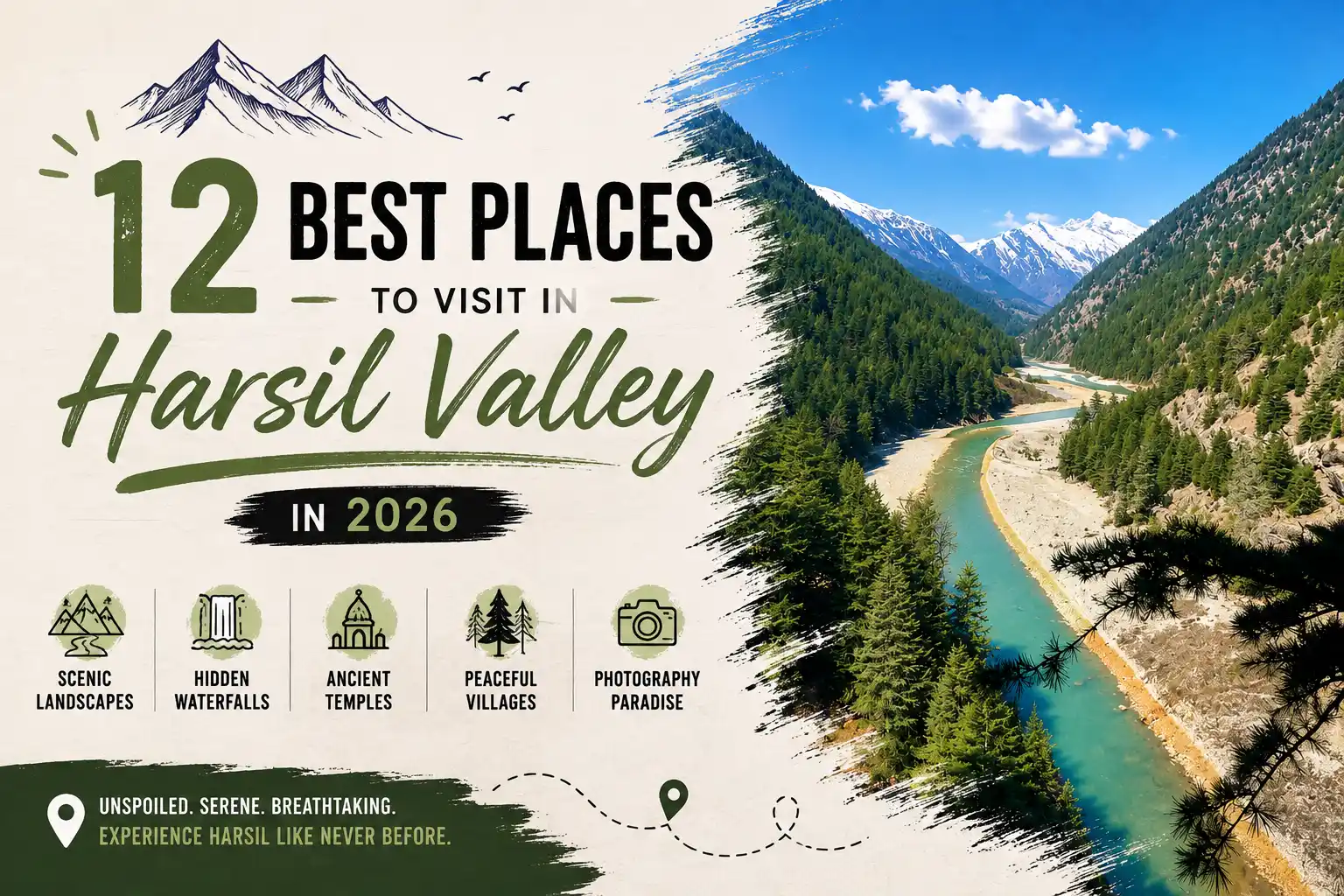
12 Best Places to Visit in Harsil Valley in 2026
If you are looking for the best places to visit in Harsil Valley, don’t think of Harsil as just another stop on the way to Gangotri. This quiet Himalayan valley has its own character: the Bhagirathi River flowing through the mountains, dense deodar forests, old villages, apple orchards and snow-covered peaks in the distance.
Located in Uttarkashi district, Harsil sits at roughly 2,600–2,700 metres above sea level and is around 20–25 km from Gangotri. The valley is also an important stop on the Gangotri route, which makes it easy to combine with a pilgrimage as well as a leisure trip. Uttarakhand Tourism describes Harsil as an unexplored valley on the banks of the Bhagirathi, while the district administration lists it among Uttarkashi’s natural and scenic attractions.
But what should you actually see once you reach Harsil?
Here are the places worth putting on your list.
Best Places to Visit in Harsil Valley at a Glance
| Place | Best For |
|---|---|
| Harsil Village | River views, forests & peaceful walks |
| Mukhba Village | Culture, temples & village life |
| Dharali | Apple orchards & local life |
| Bagori Village | Traditional architecture |
| Gangotri | Pilgrimage & Himalayan scenery |
| Gangnani | Hot springs |
| Sattal | Short trek & nature |
| Gartang Gali | History & adventure |
| Nelong Valley | High-altitude landscapes |
| Jalmagna Shivling | Unique natural formation |
| Wilson Cottage | Harsil’s history |
| Bhagirathi River | Nature & photography |
Some of these attractions are right around Harsil, while others require a drive or a short trek. That is part of the fun: Harsil Valley is best explored slowly rather than rushed through in a few hours.
1. Harsil Village
Let’s start with the place itself.
Harsil Village sits beside the Bhagirathi River and is surrounded by deodar forests and mountains. Unlike some of Uttarakhand’s busier hill destinations, Harsil still feels relatively quiet.
The district administration describes Harsil as a natural and scenic destination and notes its distinctive winter landscape, when streams can freeze and snow covers the valley.
Take a walk around the village instead of immediately getting back into your vehicle.
You’ll find wooden houses, small local shops, mountain trails and beautiful river views. Early mornings are particularly peaceful, while the evening light can make the surrounding mountains glow.
If you only have a few hours in Harsil, simply walking around Harsil itself should be high on your list.
2. Mukhba Village
Just a short distance from Harsil is Mukhba, one of the most culturally significant villages in the valley.
Mukhba is closely associated with Goddess Ganga. When the Gangotri Temple closes for winter, the idol of Goddess Ganga is brought to Mukhba, where worship continues during the colder months.
That makes the village particularly interesting if you want to understand the connection between the Gangotri pilgrimage and the communities around Harsil.
Beyond its religious significance, Mukhba is worth visiting for its traditional Himalayan architecture and quiet village atmosphere.
You don’t need a packed sightseeing schedule here.
Walk through the village. Visit the temple. Look at the old houses. Talk to locals if you get the opportunity.
That is the experience.
Mukhba Temple(Gangotri Dhaam’s stay in Winters)
4.9•Tourist attraction•Open
3. Dharali
Located close to Harsil, Dharali is another small settlement that is easy to include in your itinerary.
The village is known for its apple orchards and its location near the Bhagirathi River. During the apple season, the surrounding landscape becomes particularly attractive.
The connection between Harsil and apple cultivation goes back to Frederick Wilson, the British adventurer who settled in the region and helped introduce commercial apple and potato cultivation. Uttarakhand Tourism’s historical material also highlights Harsil’s association with Wilson and its apple-growing tradition.
Dharali is therefore more than a quick photo stop.
It gives you a glimpse into the agricultural side of life in the upper Garhwal Himalayas.
4. Bagori Village
If you enjoy places where the journey feels more interesting than a tourist attraction, add Bagori to your Harsil itinerary.
Bagori is a traditional village near Harsil known for its distinctive mountain setting and Bhotiya cultural heritage.
The village is particularly interesting for travellers who want to see a side of the region beyond temples and viewpoints.
Walk through the settlement, observe the traditional houses and take in the surrounding mountains.
It is also close enough to Harsil to make a short visit practical.
Bagori is regularly listed among the popular places to see around Harsil.
5. Gangotri
You can’t really plan a trip to Harsil without considering Gangotri.
Located further along the same mountain road, Gangotri is one of Uttarakhand’s four Char Dham pilgrimage sites and one of the most important religious destinations in the region.
The temple stands beside the Bhagirathi River, which is associated with the upper course of the Ganga.
Uttarakhand Tourism places Gangotri at roughly 3,042 metres and describes it as one of the four Char Dhams.
For travellers staying in Harsil, Gangotri makes an easy day excursion when road and weather conditions permit.
The drive itself is beautiful, with steep mountains, forests and the river accompanying you for parts of the route.
Gangotri Temple
4.8•Hindu temple•OpenWebsite
•Directions
6. Gangnani Hot Springs
On the way towards Harsil from Uttarkashi, you’ll find Gangnani, known for its natural thermal springs.
The area is associated with the Rishikund hot spring and is traditionally visited by pilgrims travelling towards Gangotri.
Uttarakhand Tourism’s Char Dham itinerary specifically recommends a halt at Gangnani for the hot spring before continuing through Harsil Valley.
It makes a good stop during a road trip, especially after spending several hours travelling through the mountains.
Think of it as a small break rather than a full-day destination.
7. Sattal — The Seven Lakes of Harsil
If you want to get away from the road, this is where things become more adventurous.
Sattal, also called Sat Tal, refers to a group of high-altitude lakes in the Harsil region.
The lakes are reached by a trek from around Dharali, making them very different from the roadside attractions around Harsil.
The route takes you through forested mountain terrain before opening up towards the lakes.
Sattal is particularly appealing to travellers who want to spend less time sightseeing from a vehicle and more time actually walking through the Himalayas.
Local tourism sources describe Sattal as a cluster of seven natural high-altitude lakes reached by an uphill trail from Dharali.
Keep in mind: conditions on mountain trails can change, so local guidance and current trail conditions matter.
8. Gartang Gali
One of the most unusual attractions near Harsil is Gartang Gali.
This historic wooden walkway is built along a steep mountain cliff and was once part of an old trade route between India and Tibet.
The district administration identifies Gartang Gali among the adventure attractions of the Uttarkashi region and connects it with the historic trade route used by the Bhotiya community.
The experience is very different from visiting a temple or viewpoint.
You are walking along a historic route carved into the mountainside, with the valley dropping away below.
Because the area is sensitive and access conditions can change, check the current permission and access requirements before planning a visit.
9. Nelong Valley
For travellers looking for something genuinely remote, Nelong Valley is one of the most fascinating places to explore from the wider Harsil region.
Located close to the India–China border, Nelong has a stark, high-altitude landscape that looks very different from the green forests around lower Harsil.
The district administration currently categorises Nelong Valley as an adventure and natural/scenic destination and notes that it is an inner-line area open to tourists during the daytime.
That restriction is important.
You cannot treat Nelong like an ordinary sightseeing drive.
Permissions, access rules, weather and local conditions need to be checked before travelling.
For those who can visit, however, the barren mountains and remote setting offer an entirely different Himalayan experience.
10. Jalmagna Shivling
The upper Harsil region is also associated with several natural and religious landmarks.
One of the lesser-known attractions often mentioned around the Harsil–Gangotri route is Jalmagna Shivling, a naturally occurring rock formation associated with Lord Shiva and the waters of the Bhagirathi.
This isn’t the kind of place you visit for a long sightseeing session.
It is more about the combination of natural surroundings and local religious beliefs.
If you are travelling towards Gangotri, ask locally about the current accessibility rather than relying entirely on an old map or itinerary.
11. Wilson Cottage
Harsil’s history is closely connected with Frederick Wilson, popularly known as Pahari Wilson.
Wilson arrived in the region during the 19th century and became associated with the local timber and apple trade. His story has become part of Harsil’s identity, particularly because of the apple cultivation he helped establish.
Wilson Cottage is therefore interesting for travellers who want to understand why Harsil became famous for apples in the first place.
However, don’t expect a large museum or conventional tourist attraction.
The historical remains and stories around Wilson are more interesting when understood in the context of the village itself.
Uttarakhand Tourism’s master-plan documentation specifically records Harsil’s old caravan-route history and its connection with Wilson and apple cultivation.
12. Bhagirathi River
Sometimes the best attraction isn’t a monument.
It is the river.
The Bhagirathi River flows directly through Harsil Valley, and spending some quiet time beside it can be one of the nicest parts of the trip.
Find a safe viewpoint near the settlement, sit for a while and listen to the water moving through the valley.
The official district description places Harsil directly within the scenic landscape of the Bhagirathi valley, while Uttarakhand Tourism also highlights Harsil’s setting beside the river and surrounding deodar forests.
Just remember that mountain rivers can be extremely powerful. Stay well away from fast-flowing water and unstable banks.
Best Places to Visit in Harsil Valley for Different Travellers
Not everyone travels to Harsil for the same reason.
For nature lovers
Go for:
Harsil → Sattal → Bhagirathi River → Dharali
For culture and history
Choose:
Mukhba → Bagori → Wilson Cottage → Gangotri
For adventure
Look at:
Sattal → Gartang Gali → Nelong Valley
Always check current access and permission requirements for restricted areas before leaving.
For a Char Dham pilgrimage
The natural combination is:
Harsil → Gangotri → Mukhba
This lets you experience both the pilgrimage and the quieter side of the region.
How Many Days Do You Need for Harsil Valley?
You can technically see the major nearby attractions in 2 days, but 3 days is much better if you want to experience Harsil rather than simply pass through it.
A simple 3-day plan
Day 1:
Reach Harsil → explore Harsil → Bhagirathi River → Dharali → Bagori
Day 2:
Mukhba → Gangotri → return to Harsil
Day 3:
Sattal or another local excursion → relax in Harsil → depart
If you want to add Nelong Valley, Gartang Gali or longer walks, allow additional time and check the current access rules.
Best Time to Visit Harsil Valley
The best time depends on what you want from the trip.
April to June
This is a beautiful period for comfortable daytime weather, green landscapes and the beginning of the travel season.
July to August
The monsoon brings lush greenery, but mountain roads can be affected by heavy rain, landslides and temporary closures.
If you travel during this period, keep your itinerary flexible.
September to November
This is one of the most rewarding periods for a Harsil trip. The monsoon usually starts retreating, the skies can become clearer and the landscape takes on an autumn feel.
Apple season also adds another reason to visit the region.
Winter
Harsil transforms completely.
Snow can cover the valley, streams may freeze and the landscape becomes dramatically different. The district administration specifically notes the contrast between summer and winter conditions in Harsil.
However, winter travel requires more preparation and you should always check current road and weather conditions.
Why Harsil Valley Is Worth Visiting
There are plenty of famous destinations in Uttarakhand.
Harsil doesn’t compete with them by being bigger or busier.
It wins by being quieter.
You get the Bhagirathi River, deodar forests, apple orchards, traditional villages and easy access to Gangotri — all within the same mountain region.
And perhaps that’s the best reason to visit.
Don’t come to Harsil expecting a long list of tourist attractions where you spend ten minutes taking a photograph before moving on.
Come for the walks.
Come for the river.
Come for the villages.
Come for the mountains.
And give yourself enough time to actually notice them.
Plan Your Harsil Valley Trip with THE DREAM TREKS
If you want to explore Harsil as part of a planned Uttarakhand trip, THE DREAM TREKS can help organise transportation and travel arrangements according to your itinerary.
Harsil can also be combined with Gangotri and the Char Dham Yatra, making it a particularly useful stop for travellers who want to experience both the spiritual and scenic sides of this part of Uttarakhand.
Plan your Harshil Valley Tour with THE DREAM TREKS and experience one of the most beautiful places Uttarakhand has to offer.
Follow us on Instagram for Regular Updates!

Recent Posts
Is Gulabi Kantha Trek Worth It? An Honest Guide for 2026

Is Kedarkantha Difficult for Beginners? An Honest 2026 Guide
Quick booking process
+91 9557062166