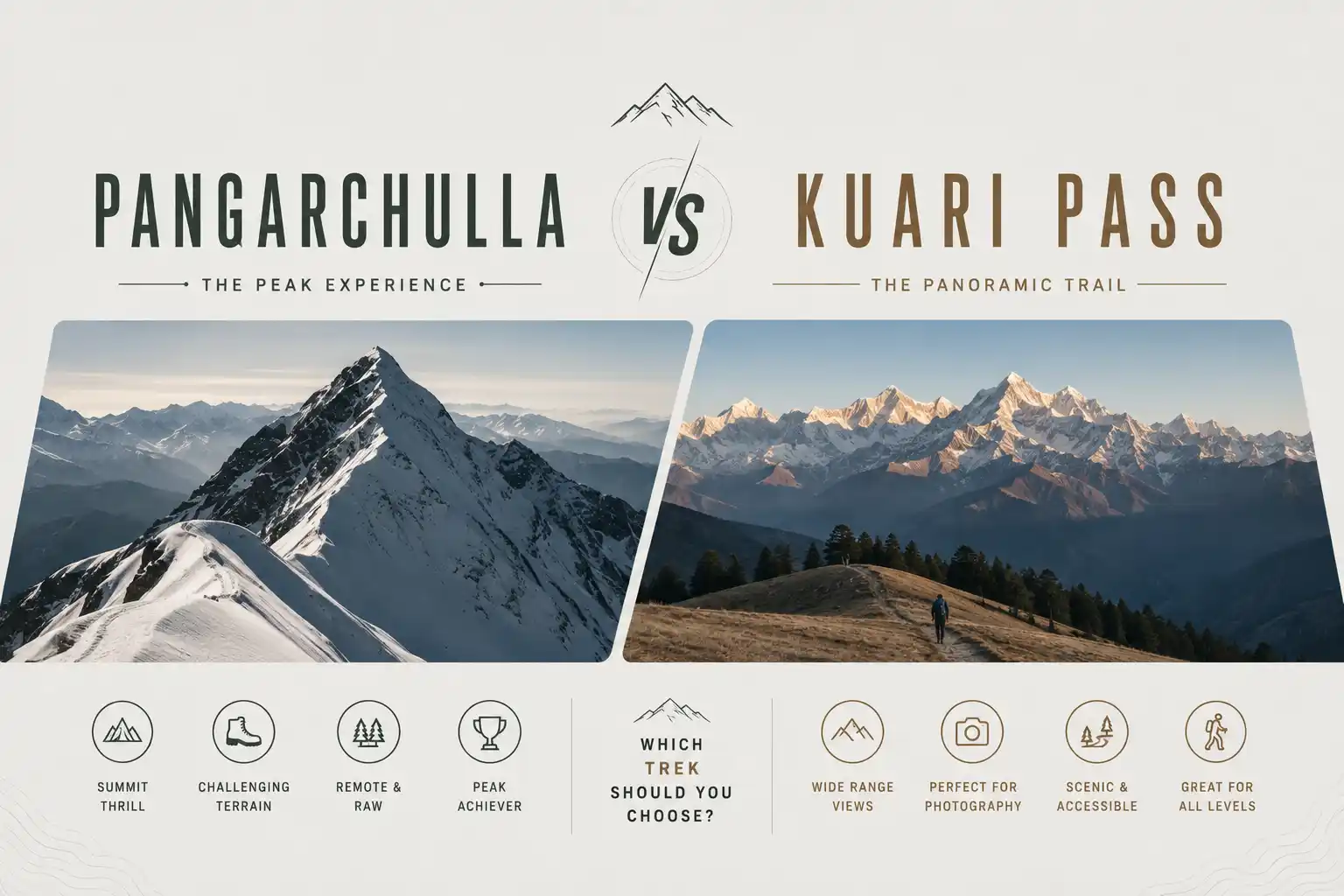
Pangarchulla vs Kuari Pass: Which Trek Should You Choose?
If you’re planning a trek in Uttarakhand and have narrowed your options down to Pangarchulla vs Kuari Pass, you’re already looking at two of the most rewarding trails in the Garhwal Himalayas. Both start around Joshimath, share some of the same mountain landscapes and can be done within roughly a week. Yet the experience is surprisingly different.
Kuari Pass is about long ridgelines, beautiful meadows, forests and some of the finest Himalayan mountain views you can get without climbing a major summit.
Pangarchulla, on the other hand, takes that experience a step further. You get Kuari Pass along the way and then attempt a proper high-altitude summit, with a much tougher final climb.
So, Pangarchulla vs Kuari Pass — which trek should you choose?
The answer depends on what you’re looking for: a scenic Himalayan journey or a more demanding summit adventure.
Pangarchulla vs Kuari Pass: What’s the Main Difference?
The easiest way to understand the difference is to look at what each trek is trying to offer.
Kuari Pass is primarily a high-altitude pass trek. The trail takes you through forests, open meadows and ridges before reaching Kuari Pass, with huge views of peaks such as Nanda Devi, Dronagiri, Kamet and Chaukhamba.
Pangarchulla combines much of that experience with an additional summit attempt.
On the Pangarchulla route, trekkers reach the Khullara campsite, explore Kuari Pass and then make a summit push towards Pangarchulla Peak. The summit day is considerably longer and more demanding, particularly when snow conditions are present.
That additional summit is what changes the character of the trek.
Pangarchulla vs Kuari Pass: Which Trek Is More Difficult?
If difficulty is your main concern, Pangarchulla is harder than Kuari Pass.
Kuari Pass still requires good stamina because of the altitude and long walking days, but its overall route is more manageable for trekkers with a reasonable level of fitness.
Pangarchulla adds a serious summit day to the experience.
The climb can become particularly challenging near the upper sections, where the gradient increases and snow can make every step slower. Depending on conditions, microspikes or other traction equipment may be necessary.
The summit push can also involve 14–16 km of round-trip walking from the campsite, making it one of the most physically demanding days of the trek.
So if you’re comparing Pangarchulla vs Kuari Pass difficulty, the advantage clearly goes to Kuari Pass for trekkers looking for the easier option.
Pangarchulla vs Kuari Pass: Which Has Better Views?
This is where the comparison becomes much harder.
Both treks have spectacular views.
Kuari Pass is famous for its panoramic Himalayan scenery. The trail moves through forests and open alpine landscapes, eventually opening up to enormous views of some of the highest peaks in the Garhwal Himalayas.
Pangarchulla gives you much of the same scenery.
But then you climb higher.
From Pangarchulla Peak, the surrounding mountains appear to stretch in every direction. On a clear day, the summit provides an incredible perspective of the Garhwal range.
For someone who loves summit experiences, Pangarchulla has the edge.
For someone who enjoys walking through changing landscapes rather than chasing a summit, Kuari Pass can actually feel more rewarding.
What Is the Pangarchulla Trek Like?
The Pangarchulla Trek is best thought of as a combination of a scenic pass trek and a summit climb.
A typical itinerary starts from Rishikesh and heads towards Joshimath. From there, trekkers drive towards Dhak before beginning the trek to the Khullara campsite.
The next stage takes you towards Kuari Pass and back.
Then comes the big day.
The climb from Khullara towards Pangarchulla Peak is long and demanding. Depending on trail and snow conditions, trekkers may cover around 14–16 km round trip on summit day.
After the summit attempt, the trail descends back towards Joshimath before the final drive to Rishikesh.
The trek is therefore not just about reaching one point.
It’s about handling several demanding days in the mountains before and after the summit.
What Is the Kuari Pass Trek Like?
The Kuari Pass Trek offers a different experience.
Rather than focusing on a major summit climb, the trek revolves around reaching the historic Kuari Pass and exploring the surrounding high-altitude landscapes.
The trail generally passes through forests, meadows and ridges, with changing views of the Himalayan peaks throughout the journey.
One of the best things about Kuari Pass is the feeling of walking along a Himalayan ridge with enormous mountains in the distance.
You get the adventure of high-altitude trekking without the same summit-day intensity found on Pangarchulla.
That’s why Kuari Pass is often the more comfortable choice for trekkers who want scenery, landscapes and a challenging but manageable trek.
Pangarchulla vs Kuari Pass: Which Is Better for Beginners?
If this is your first Himalayan trek, Kuari Pass is generally the better choice.
That doesn’t mean you should underestimate it.
You still need reasonable cardiovascular fitness and enough leg strength to handle long walking days. Altitude also remains an important factor.
However, Pangarchulla’s summit day adds another level of difficulty.
If you’ve already completed a few Himalayan treks and want to challenge yourself with a summit, Pangarchulla becomes much more attractive.
A simple way to look at it is:
First serious Himalayan trek → Kuari Pass
Experienced trekker looking for a summit → Pangarchulla
Of course, your individual fitness and previous trekking experience matter more than these labels.
Which Trek Has Better Snow?
If you’re specifically looking for a snow trek, Pangarchulla is the more exciting option.
Winter and early-season conditions can transform the upper sections into a completely different landscape. Snow adds both beauty and difficulty, particularly around the summit.
Kuari Pass can also receive substantial snowfall during the winter season, creating beautiful snow-covered forests, meadows and ridges.
However, Pangarchulla’s summit push gives you a more dramatic high-altitude snow experience.
That comes with a catch.
Snow can make the trek significantly harder.
Your pace slows down, footing becomes more complicated and the physical effort increases.
So don’t choose Pangarchulla simply because you want photographs in the snow.
Choose it because you’re comfortable with the additional challenge that comes with those conditions.
Pangarchulla vs Kuari Pass: Which One Takes More Fitness?
Both require preparation, but Pangarchulla demands more.
For Kuari Pass, you should be comfortable walking for several hours and handling consecutive trekking days.
For Pangarchulla, you need stronger endurance because the summit day can be long and physically demanding.
Your training should include:
- Long-distance walking
- Stair climbing
- Squats and lunges
- Step-ups
- Cardiovascular training
- Walking with a backpack
If you’re preparing for Pangarchulla, it is particularly useful to include long walks and stair sessions in your training.
The summit isn’t the time to discover that your legs aren’t ready.
Pangarchulla vs Kuari Pass: Which Has the Better Overall Experience?
This depends entirely on what you want from your trek.
If you enjoy slow mountain walks, forests, meadows, ridges and long views, Kuari Pass may be your ideal choice.
If you want all of that plus the satisfaction of standing on a high Himalayan summit, Pangarchulla is difficult to beat.
Pangarchulla also has an interesting advantage: the experience isn’t limited to the summit.
The route incorporates the Kuari Pass region, meaning you’re getting many of the landscapes that make Kuari Pass famous while also adding a summit challenge.
That’s one reason experienced trekkers often find Pangarchulla particularly rewarding.
Pangarchulla vs Kuari Pass: Quick Comparison
| Feature | Pangarchulla | Kuari Pass |
|---|---|---|
| Type | Pass + summit trek | Pass trek |
| Difficulty | Difficult | Moderate |
| Summit | Yes – Pangarchulla Peak | No major summit |
| Highest point | Around 4,590 m | Around 3,650 m |
| Fitness required | Good to high | Moderate to good |
| Snow experience | Excellent in suitable season | Excellent in suitable season |
| Best for | Experienced trekkers & summit seekers | Scenic trekking & first serious Himalayan trek |
| Major attraction | Pangarchulla summit + Kuari Pass region | Kuari Pass + Himalayan panoramas |
| Summit day | Long and demanding | No equivalent summit push |
| Overall experience | More challenging and adventurous | More relaxed and scenic |
So, Pangarchulla or Kuari Pass?
Here’s the simplest way to decide.
Choose Kuari Pass if:
You want a beautiful Himalayan trek without an extremely demanding summit day.
You’re relatively new to Himalayan trekking.
You enjoy forests, meadows, ridgelines and panoramic mountain views.
You want a challenging trek but don’t necessarily need a summit to make it memorable.
Choose Pangarchulla if:
You’ve already done a few Himalayan treks.
You want to test your endurance.
You specifically want a summit experience.
You enjoy snow and don’t mind slower, harder trekking conditions.
You want a trek that combines the Kuari Pass region with a more demanding summit push.
The Verdict: Which Trek Should You Choose?
The Pangarchulla vs Kuari Pass debate doesn’t really have one universal winner.
It comes down to the kind of mountain experience you’re looking for.
Kuari Pass is the better choice if you want a scenic, rewarding Himalayan trek with a strong focus on landscapes and mountain views.
Pangarchulla is the better choice if you want to push yourself further and experience the satisfaction of reaching a Himalayan summit.
And if you’re wondering whether Pangarchulla is simply a harder version of Kuari Pass, there’s an important distinction.
It isn’t.
The two treks share a region and some landscapes, but they create different experiences.
Kuari Pass asks you to enjoy the journey.
Pangarchulla asks you to enjoy the journey and then earn the summit.
If you’ve got the fitness and the appetite for a bigger challenge, Pangarchulla is the one we’d pick.
All set and ready to book your spot? Contact us!
Follow us on Instagram for Regular Updates!

Recent Posts
Pangarchulla vs Kuari Pass: Which Trek Should You Choose?

K2 vs Everest: Which Mountain Is More Difficult to Climb?

How to Train for a Himalayan Trek at Home
Quick booking process
+91 9557062166