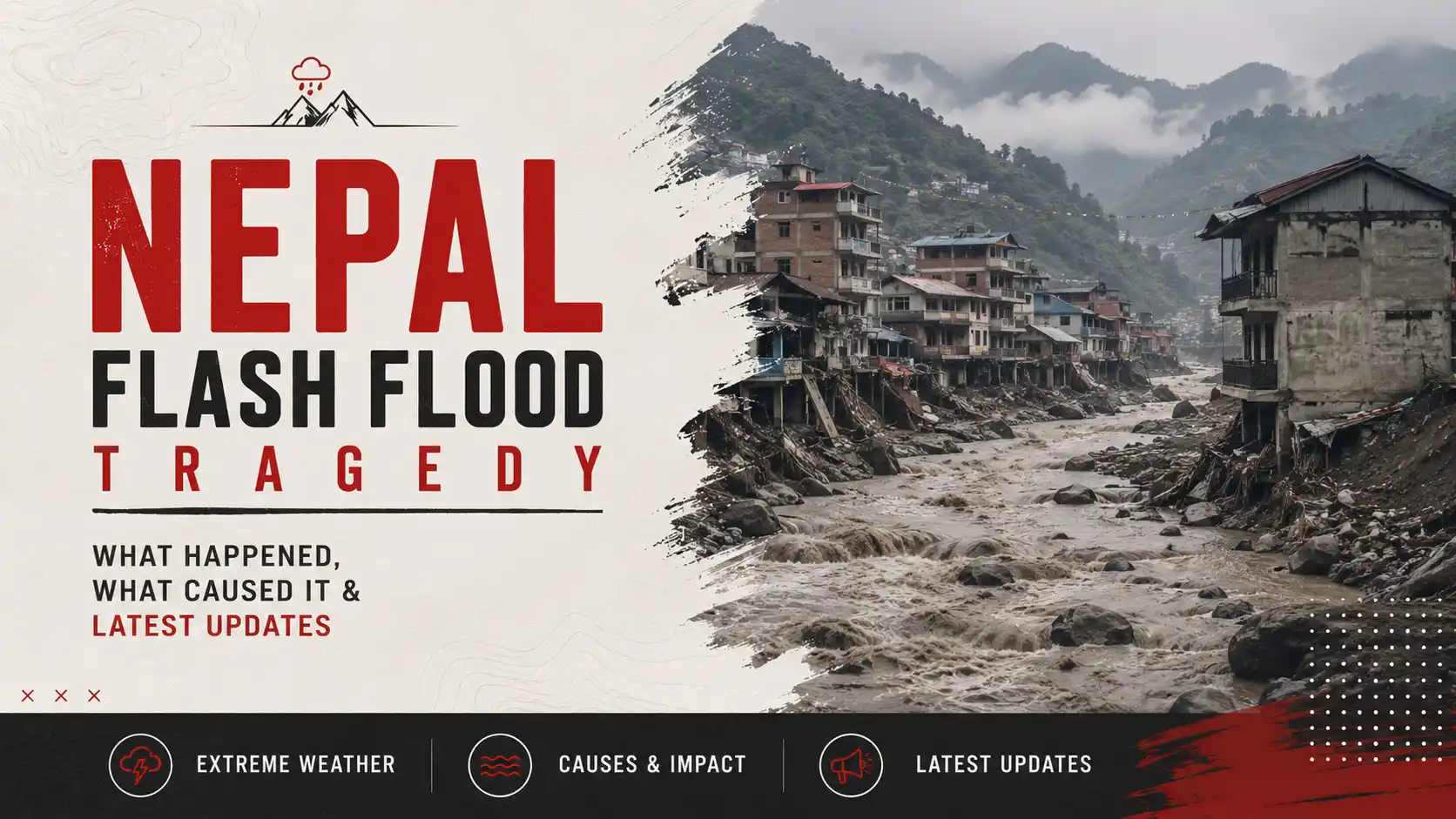
Nepal Flash Flood Tragedy: What Happened, What Caused It & Latest Updates
A devastating Nepal flash flood struck the country’s northern Rasuwa district on August 26, sending a huge surge of water, mud, ice and debris through settlements along the Bhote-koshi River. The disaster has killed at least 165 people in Nepal, while hundreds more remain unaccounted for. Many of those missing are tourists and pilgrims travelling through the region toward the Nepal–China border and Mount Kailash.
The scale of the destruction is still being assessed. Roads and bridges have disappeared, hydropower infrastructure has been damaged and entire settlements along the river have been swept away.
For travellers and trekking communities across the Himalayas, the tragedy is a sobering reminder of how quickly conditions can change in high mountain regions.
Here is what we know about the Nepal flash flood, how it happened and where the rescue operation stands as of August 27, 2026.
What Happened in Nepal?
The disaster began in the mountainous area around Rasuwa, near the Nepal–China border.
A massive surge entered Nepal’s Bhote-koshi River from the Tibetan side on the morning of August 26. The flood then moved rapidly downstream through the Bhote-koshi and Trishuli river systems.
Timure, near the Rasuwagadhi border crossing, was among the first areas to be severely affected. The flood then travelled towards Syabrubesi and other settlements further downstream.
According to Nepal’s Flood Forecasting Division, authorities received information about the major flood entering the Bhote-koshi at around 9:05 AM. Alerts were subsequently sent to downstream communities, with more than 600,000 SMS messages reportedly issued to people in vulnerable areas.
For people near the source of the flood, however, there was very little time to react.
What Caused the Nepal Flash Flood?
This is one of the most important parts of the story.
The disaster was not caused by ordinary heavy rainfall in Rasuwa.
Initial assessments indicate that an ice or glacial avalanche blocked the Lhende River on the Tibetan side, creating a temporary blockage. Water and debris accumulated behind it before the blockage failed, releasing a powerful surge downstream.
Satellite imagery analysed by authorities indicated that the blockage occurred roughly 20 kilometres upstream of the Miteri Bridge.
A magnitude 4.4 earthquake was also recorded in the Tibetan region at around 8:37 AM, shortly before the flood entered Nepal. However, authorities and scientists have continued investigating the exact relationship between the earthquake, the ice avalanche and the flood.
The US Geological Survey’s analysis has also pointed to a major glacial collapse rather than a conventional rainfall-driven flood.
So, while the precise chain of events is still being investigated, the picture emerging is:
Ice/glacial collapse → river blockage → sudden release → debris-filled flash flood → massive downstream destruction.
Why Was the Flood So Destructive?
The speed and volume of the water were major factors.
This wasn’t simply a river gradually rising after hours of rain.
A huge amount of water and debris was released almost suddenly into a narrow Himalayan valley. The surge carried mud, rocks, ice and other debris, giving people living near the river extremely little time to escape.
Witnesses described the flood as a wall of water and debris moving through settlements.
The force was enough to sweep away vehicles, houses, bridges and sections of roads.
According to Nepal’s Department of Roads, the 42-kilometre road connecting Betrawati and the Rasuwagadhi border crossing was heavily damaged, with several bridges washed away.
How Many People Have Died in the Nepal Flood?
As of August 27, 2026, at least 165 people have been confirmed dead in Nepal, according to the latest reports from Nepali authorities and international news agencies. The death toll is expected to change as rescue teams reach more affected areas and identify recovered bodies.
The disaster has also affected areas on the Tibetan side of the border, where Chinese authorities have reported additional deaths and hundreds of people missing.
Because rescue teams are still searching remote areas, the final number of casualties is not yet known.
How Many People Are Missing?
This figure is changing rapidly.
Nepal’s latest reported figures put the number of people missing at 826, including residents, security personnel and tourists. The Nepal Tourism Board has separately reported 590 tourists out of contact, including 476 foreign nationals and 114 Nepali tourists.
Among the foreign tourists reported missing are:
- 177 Indians
- 63 Americans
- 53 Ukrainians
- 34 Australians
- 33 British nationals
- 25 Canadians
- 8 Germans
- 6 Singaporeans
- 6 South Africans
These numbers represent people reported out of contact, not confirmed deaths. Search teams are still working to locate them.
Across Nepal and Tibet combined, the number of people reported missing has been much higher in some international assessments, approaching 1,500. The figures differ because Nepal and Chinese authorities are reporting separate affected populations and the lists are still being verified.
Tourists and Pilgrims Among Those Missing
The affected region isn’t just home to local communities.
The route through Rasuwa is important for cross-border travel and is also used by tourists, trekkers and pilgrims travelling towards Mount Kailash and Tibet.
That is why such a large number of foreign nationals were caught up in the disaster.
Nepal’s Tourism Board has been working with authorities to identify travellers who were in the affected area and determine whether they have reached safety.
Some groups have already been located or rescued, while others remain unaccounted for.
The situation is still developing, so lists of missing travellers should not automatically be treated as confirmed casualty lists.
What Damage Has the Flood Caused?
The physical destruction is enormous.
Reports indicate damage to:
- Roads
- Bridges
- Houses
- Markets
- Hydropower projects
- Police facilities
- Customs infrastructure
- Vehicles
- Communication networks
- Electricity infrastructure
At least 19 motorable bridges and around 40 kilometres of road were reported damaged in early assessments. Several hydropower projects were also affected.
The destruction has also severely disrupted access to the border region.
Some areas remain difficult to reach, making the rescue operation even harder.
How Is the Rescue Operation Going?
Nepali security forces, including the Nepali Army, Nepal Police and Armed Police Force, are involved in the search and rescue operation.
Helicopters have been deployed to reach isolated areas and evacuate injured people.
However, the operation has faced major challenges.
Poor weather has repeatedly disrupted helicopter flights. Mud, destroyed roads, damaged bridges and communication failures have also made it difficult for rescue teams to reach some communities.
More than a hundred people have already been rescued, but teams are continuing to search riverbanks, settlements and downstream areas for survivors and missing people.
Were People Warned About the Flood?
This is one of the difficult questions emerging from the disaster.
Nepal’s Flood Forecasting Division did issue warnings to downstream communities after receiving information that a major flood had entered the Bhotekoshi.
More than 600,000 SMS alerts were reportedly sent to vulnerable communities further downstream.
The problem was timing.
The flood originated across the border and moved extremely quickly. Nepal’s monitoring stations near the river were themselves damaged or swept away, limiting the ability of the existing system to provide an earlier warning to communities closest to the source.
That has raised important questions about cross-border early-warning systems in the Himalayas.
Could This Happen Again?
Authorities have warned people living near major rivers to remain cautious while rescue and recovery operations continue.
The concern isn’t limited to this single flood.
Himalayan valleys are naturally vulnerable to flash floods, landslides, glacial lake outburst floods and sudden ice or debris collapses. Climate change is also increasing concern about the stability of glaciers and high-altitude environments.
However, it would be too early to say that every future flood in the region will follow the same pattern.
The key lesson from this disaster is the importance of better monitoring, faster communication and stronger cross-border warning systems.
What Does This Mean for Travellers?
For anyone planning to travel through the Himalayas, this tragedy is a reminder to take mountain conditions seriously.
A route can look perfectly safe in the morning and become dangerous within minutes when a major natural event occurs upstream.
Travellers should:
- Check official weather and travel advisories.
- Stay updated on road conditions.
- Follow instructions from local authorities.
- Avoid riverbanks during periods of heightened risk.
- Keep emergency contacts accessible.
- Travel with an experienced operator when visiting remote mountain regions.
- Never assume that clear weather means every mountain route is safe.
For trekking and pilgrimage groups, communication between the operator, local authorities and travellers is especially important.
The Himalayas Demand Respect
The Nepal flash flood tragedy is still unfolding, and the final human cost is not yet known.
Behind every number are families waiting for news, communities trying to find their homes and rescue teams working in extremely difficult terrain.
For those of us who work and travel in the Himalayas, events like this are a reminder that these mountains are beautiful but never completely predictable.
The right response isn’t fear of the mountains.
It is respect for them.
Better preparation, responsible travel and reliable information can make a real difference when conditions change unexpectedly.
Our thoughts are with everyone affected by the disaster, the families still waiting for news and the rescue teams working through the aftermath.
Nepal Flash Flood: Latest Update — August 27, 2026
As of August 27, 2026:
- At least 165 people have died in Nepal.
- 826 people are reported missing in Nepal.
- 590 tourists are among those reported out of contact, including 476 foreigners.
- 177 Indian tourists are among the foreign nationals reported missing.
- Search and rescue operations are continuing.
- Helicopter operations are being affected by difficult weather.
- Roads, bridges, settlements and hydropower infrastructure have suffered extensive damage.
- The disaster appears to have been triggered by an ice/glacial collapse and river blockage, rather than heavy rainfall in Rasuwa.
- A 4.4-magnitude earthquake occurred in Tibet shortly before the flood, but the exact relationship between the earthquake and the glacial collapse remains under investigation.
- Authorities continue to warn communities downstream and assess the possibility of further flooding.
These figures are changing as rescue teams continue their work. This article should be updated whenever Nepalese authorities release a new verified casualty or missing-person figure.
Want to read more? Check-out our other Blogs!
Follow us on Instagram for Regular Updates!
Frequently Asked Questions
What happened in Nepal on August 26, 2026?
A catastrophic flash flood entered Nepal’s Bhotekoshi River from the Tibetan side near the Rasuwa border. The surge swept through settlements, roads and infrastructure along the river.
What caused the Nepal flash flood?
Initial assessments indicate that an ice or glacial avalanche blocked the Lhende River, creating a temporary blockage that later failed and released a powerful surge downstream. Authorities are still investigating the exact sequence of events.
How many people died in the Nepal flash flood?
As of August 27, at least 165 people have been confirmed dead in Nepal. The number may rise as rescue teams reach more affected areas.
How many people are missing in Nepal?
The latest Nepalese figures report 826 people missing, including tourists, residents and security personnel.
Are Indian tourists missing in Nepal?
Yes. Nepal’s Tourism Board has reported 177 Indian tourists among the foreign nationals currently reported out of contact. These are missing-person reports and do not mean that those individuals are confirmed dead.
Was the Nepal flood caused by heavy rain?
No. Reports from Nepal’s Department of Hydrology and Meteorology indicate that there was no heavy rainfall in the Rasuwa area when the disaster occurred. The leading explanation is a sudden upstream ice/glacial collapse and river blockage.
Is it safe to travel to Nepal right now?
Travel safety depends heavily on the specific region. The areas affected by the flood should be avoided while rescue and recovery operations continue. Travellers should check current government and local authority advisories before travelling.

Recent Posts

Is Gulabi Kantha Trek Worth It? An Honest Guide for 2026


Is Kedarkantha Difficult for Beginners? An Honest 2026 Guide
Quick booking process
+91 9557062166