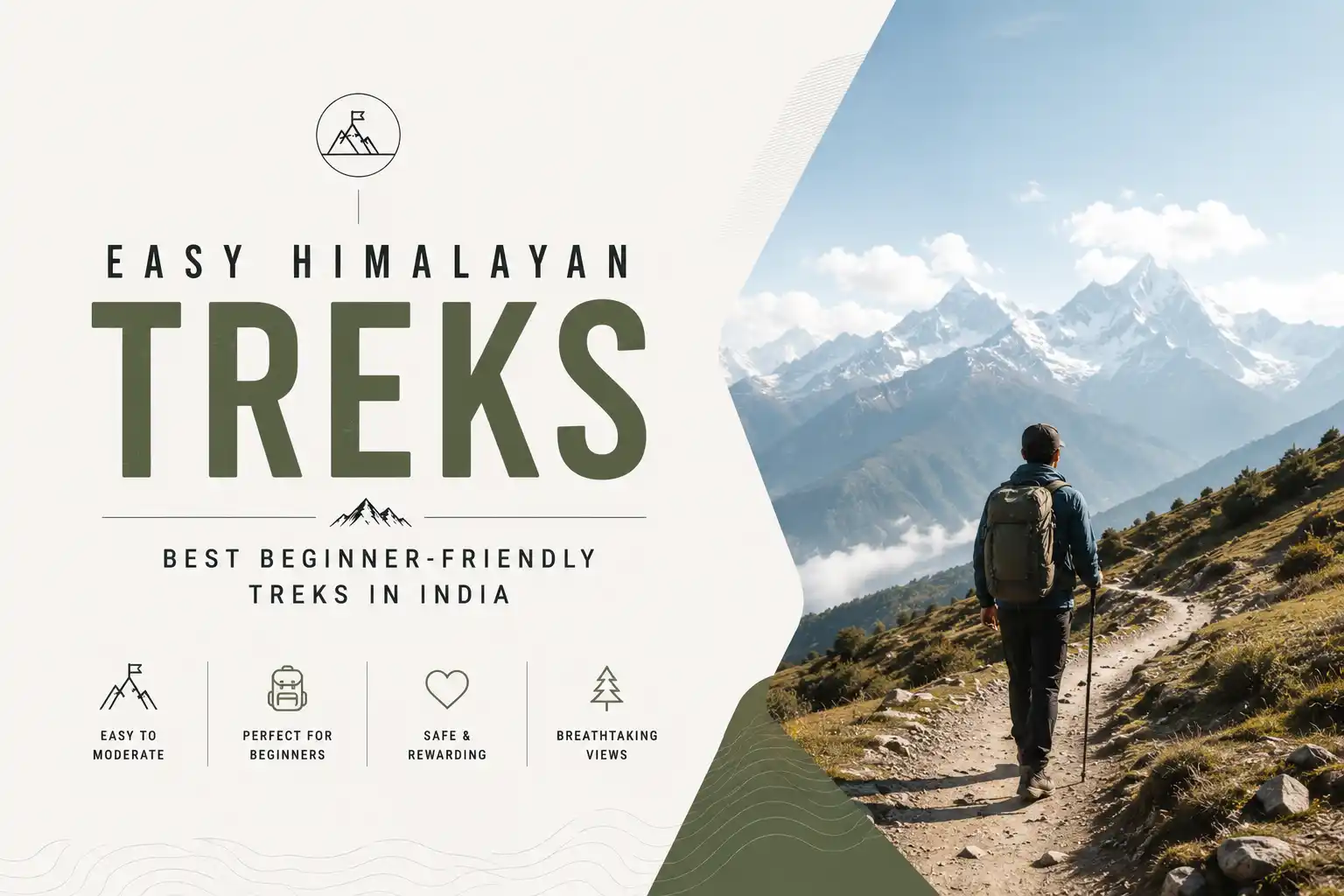
Easy Himalayan Treks: Best Beginner-Friendly Treks in India
If you’re searching for easy Himalayan treks, chances are you’re looking for your first real experience in the mountains. Maybe you’ve never trekked before. Maybe the thought of walking for several hours at high altitude sounds intimidating. Or perhaps you simply want a beautiful Himalayan trail without signing yourself up for an exhausting summit expedition.
The good news is that you don’t have to be an experienced mountaineer to explore the Himalayas.
There are several easy Himalayan treks that offer forests, meadows, mountain views, alpine lakes and even summit experiences without the extreme difficulty associated with technical high-altitude routes. Treks such as Nag Tibba, Dayara Bugyal and Kedarkantha are popular starting points, while routes such as Valley of Flowers and Chopta-Chandrashila sit closer to the easy-to-moderate end of the spectrum.
But there’s one thing worth clearing up before we begin.
Easy doesn’t mean effortless.
Even the most beginner-friendly Himalayan trek involves climbing, walking for several hours, uneven terrain and changes in altitude. The right trek is one that challenges you without overwhelming you.
So, which trek should you choose?
Let’s find out.
What Makes a Himalayan Trek “Easy”?
Trek difficulty isn’t decided by altitude alone.
A trek at 4,000 metres isn’t automatically harder than every trek below 4,000 metres. The distance you walk each day, steepness of the trail, altitude gain, weather, terrain and number of consecutive trekking days all matter.
That’s why easy Himalayan treks usually have a combination of manageable daily distances, established trails and gradual altitude gain.
For a beginner, another important factor is how you feel after each day.
You don’t want to finish Day 1 wondering how you’re possibly going to walk again tomorrow.
A good first trek should leave you tired, but still excited about the next morning.
Best Easy Himalayan Treks for Beginners
There isn’t one perfect trek for everyone. Your choice should depend on the season, your fitness and the kind of experience you want.
Here are some of the best options to consider.
1. Nag Tibba Trek — A Great First Himalayan Trek
If you’ve never done a Himalayan trek before, Nag Tibba is one of the easiest places to start.
Located in the Garhwal Himalayas, Nag Tibba reaches around 3,022 metres and can be completed in a short two-day itinerary. Uttarakhand Tourism classifies it as easy to moderate and specifically describes it as suitable for beginners.
The trail begins from Panthwari and takes you through forested sections before opening up towards the summit.
And that’s what makes Nag Tibba so appealing.
You don’t need to take a week off work to experience the Himalayas.
You can leave Dehradun, reach the trailhead, spend a night in the mountains and return with your first Himalayan summit under your belt.
The summit also offers wide views towards peaks including Bandarpoonch, Kala Nag, Srikanth and the Gangotri range.
Best for: First-time trekkers, short getaways and people with limited time.
2. Dayara Bugyal — For Those Who Want Wide Open Mountains
Some treks impress you with a summit.
Dayara Bugyal impresses you with space.
The trail takes you towards one of Uttarakhand’s famous high-altitude meadows, where rolling grasslands replace dense forests and the horizon suddenly feels enormous.
Uttarakhand Tourism describes Dayara Bugyal as an easy trek that can be attempted by beginners, while also noting its easy-to-moderate classification in its trekking information.
The scenery changes beautifully with the season.
During warmer months, the meadow turns green and wildflowers add colour to the landscape. In winter, snow transforms the same terrain into a completely different world.
You’ll also get views towards peaks such as Bandarpoonch, Srikanth, Draupadi Ka Danda and Jaunli.
Best for: Beginners who want beautiful meadows, mountain views and a proper multi-day trekking experience.
3. Kedarkantha — The Beginner-Friendly Snow Trek
If your idea of a Himalayan trek involves snow, pine forests and a summit, Kedarkantha is hard to ignore.
Uttarakhand Tourism describes Kedarkantha as an easy option for beginners and classifies the trek as easy to moderate. The route reaches around 3,800 metres and passes through Govind Pashu Vihar National Park.
One of the biggest attractions is the seasonal transformation of the trail.
In winter, forests and campsites can be covered in snow. The summit day involves an early start and a climb to Kedarkantha Peak, followed by a descent through the mountain landscape.
That makes Kedarkantha particularly attractive for someone who wants their first trek to feel like a proper Himalayan adventure rather than simply a mountain walk.
There is a summit.
There is snow.
There are mountain views.
And you don’t need advanced mountaineering skills.
Best for: Beginners looking for their first snow trek or summit experience.
4. Chopta–Chandrashila — Easy Trek, Big Views
The Chopta–Chandrashila route is another popular option, although it sits closer to easy to moderate rather than being a truly easy trek.
Uttarakhand Tourism classifies the route as easy to moderate. The trail passes through Deoriatal, forests and meadows before reaching Tungnath and then continuing towards Chandrashila.
The final climb to Chandrashila is where the difficulty increases.
In winter, snow can cover the route, and the climb from Tungnath to Chandrashila becomes considerably more demanding.
But the reward is enormous.
From the summit, you can see a wide collection of Himalayan peaks, including Chaukhamba, Nanda Devi, Trishul, Kedar Dome and others.
So while it may not be the easiest trek on this list, it’s an excellent choice for a reasonably fit beginner who wants a little more adventure.
Best for: Fit beginners who want forests, a temple, a summit and big Himalayan views.
5. Valley of Flowers — A Different Kind of Himalayan Trek
When people imagine Himalayan trekking, they often picture snow-covered peaks.
The Valley of Flowers offers something completely different.
During its short summer monsoon season, the landscape comes alive with alpine flowers, green slopes, waterfalls and misty mountain scenery.
The approach to Ghangaria includes a substantial uphill walk, and Uttarakhand Tourism describes the overall Valley of Flowers trek as moderate to challenging. So it shouldn’t be treated as an effortless beginner trek simply because it lacks technical climbing.
That distinction matters.
For a reasonably fit beginner, the trek can be manageable, but the distance, altitude and long walking days still require preparation.
If you’re looking for easy Himalayan treks primarily because you want a beautiful first mountain experience rather than a summit challenge, however, Valley of Flowers can be a very appealing choice.
Best for: Nature lovers, photographers and trekkers who prefer scenery over summit climbing.
Which Easy Himalayan Trek Is Best for You?
This is where choosing a trek becomes more interesting.
Don’t simply pick the trek with the lowest altitude.
Think about what you actually want to experience.
Want the shortest introduction to Himalayan trekking?
Nag Tibba is a great place to start.
Want huge meadows and open mountain landscapes?
Choose Dayara Bugyal.
Want snow and your first Himalayan summit?
Go for Kedarkantha.
Want a little more challenge and incredible summit views?
Consider Chopta–Chandrashila.
Want flowers, waterfalls and monsoon landscapes?
Valley of Flowers is the obvious choice, provided you’re prepared for its longer walking days.
Easy Himalayan Treks vs Moderate Treks: What’s the Difference?
The word “easy” can sometimes create the wrong expectations.
A beginner-friendly trek may still involve walking 6–8 hours on some days. You may climb hundreds of metres in elevation. You may wake up early. Your legs will probably be sore.
The difference is that you aren’t dealing with the technical climbing, extreme exposure or extremely demanding summit pushes found on more difficult Himalayan routes.
This is why fitness still matters.
You don’t need to be exceptionally athletic, but being able to walk comfortably for a few hours before your trek will make the experience much more enjoyable.
How Fit Do You Need to Be for an Easy Himalayan Trek?
You don’t need to run marathons.
For most beginner-friendly routes, start by building a basic level of endurance.
Regular walking is the best place to begin.
Try walking for 30–60 minutes several times a week. As your trek approaches, add longer walks and some stair climbing.
Simple exercises such as squats, lunges and step-ups can also strengthen your legs.
The objective isn’t to become extremely fit.
It’s to make sure that your first day in the Himalayas isn’t also your first day of serious physical activity.
Are Easy Himalayan Treks Safe for Beginners?
They can be, provided you prepare properly and respect the mountains.
The biggest mistake beginners make is assuming that an easy trek means there are no risks.
Altitude still matters.
Weather can change quickly.
Trails can become slippery.
And even a relatively easy route can feel much harder if you’re dehydrated, poorly rested or carrying too much weight.
Always check current weather and route conditions before leaving, follow local instructions and avoid pushing through symptoms that could indicate a serious problem.
The mountains don’t reward stubbornness.
When Is the Best Time for Easy Himalayan Treks?
There isn’t one season that works for every trek.
Winter is ideal if you’re specifically looking for snow on routes such as Kedarkantha and Dayara Bugyal.
Spring brings rhododendron blooms to several lower and mid-altitude trails, making routes around Chopta particularly beautiful.
Summer offers greener landscapes and generally more accessible high-altitude trails.
Monsoon creates spectacular greenery and makes the Valley of Flowers particularly special, although rain can also make trails slippery and conditions more unpredictable.
So instead of asking, “What is the best month for an easy Himalayan trek?”, ask:
Which trek do I want to do, and what do I want to see?
What Should You Carry on a Beginner Trek?
One of the easiest ways to make an easy trek unnecessarily difficult is carrying too much.
Your backpack should contain what you genuinely need rather than everything you might possibly use.
Good trekking shoes, appropriate layers, rain protection, water, personal medicines, basic toiletries, snacks and a few essential accessories should cover the basics.
Pack for the conditions of your specific trek.
A winter trek and a monsoon trek obviously won’t require exactly the same gear.
And remember: every extra kilogram is something you’ll carry uphill.
Easy Himalayan Treks Don’t Mean Easy Mountains
This might be the most important thing to remember.
The term easy Himalayan treks describes the relative difficulty of a route.
It doesn’t mean the Himalayas suddenly become flat.
You will still climb.
You will still get tired.
You may still struggle on a steep section.
And there will probably be moments when you wonder why you thought trekking was a good idea.
Then you’ll turn a corner, see a huge mountain rising above the valley, and understand.
That’s the magic of trekking.
Final Thoughts
Your first Himalayan trek doesn’t need to be the hardest thing you’ve ever done.
In fact, it probably shouldn’t be.
The best beginner trek is one that gives you enough challenge to feel like an adventure while still allowing you to enjoy the scenery, the campsites, the people and the journey.
That’s why easy Himalayan treks are such a great starting point.
Start with Nag Tibba if you want something short.
Choose Dayara Bugyal if you dream of walking across vast mountain meadows.
Pick Kedarkantha if snow and summits are calling.
Try Chopta–Chandrashila if you’re ready for a little more effort.
Or head towards Valley of Flowers if your idea of the Himalayas is a valley bursting with colour.
You don’t have to conquer the Himalayas on your first attempt.
You just have to take the first step.
All set and ready to book your spot? Contact us!
Follow us on Instagram for Regular Updates!

Recent Posts
Easy Himalayan Treks: Best Beginner-Friendly Treks in India

Pangarchulla vs Kuari Pass: Which Trek Should You Choose?

K2 vs Everest: Which Mountain Is More Difficult to Climb?
Quick booking process
+91 9557062166