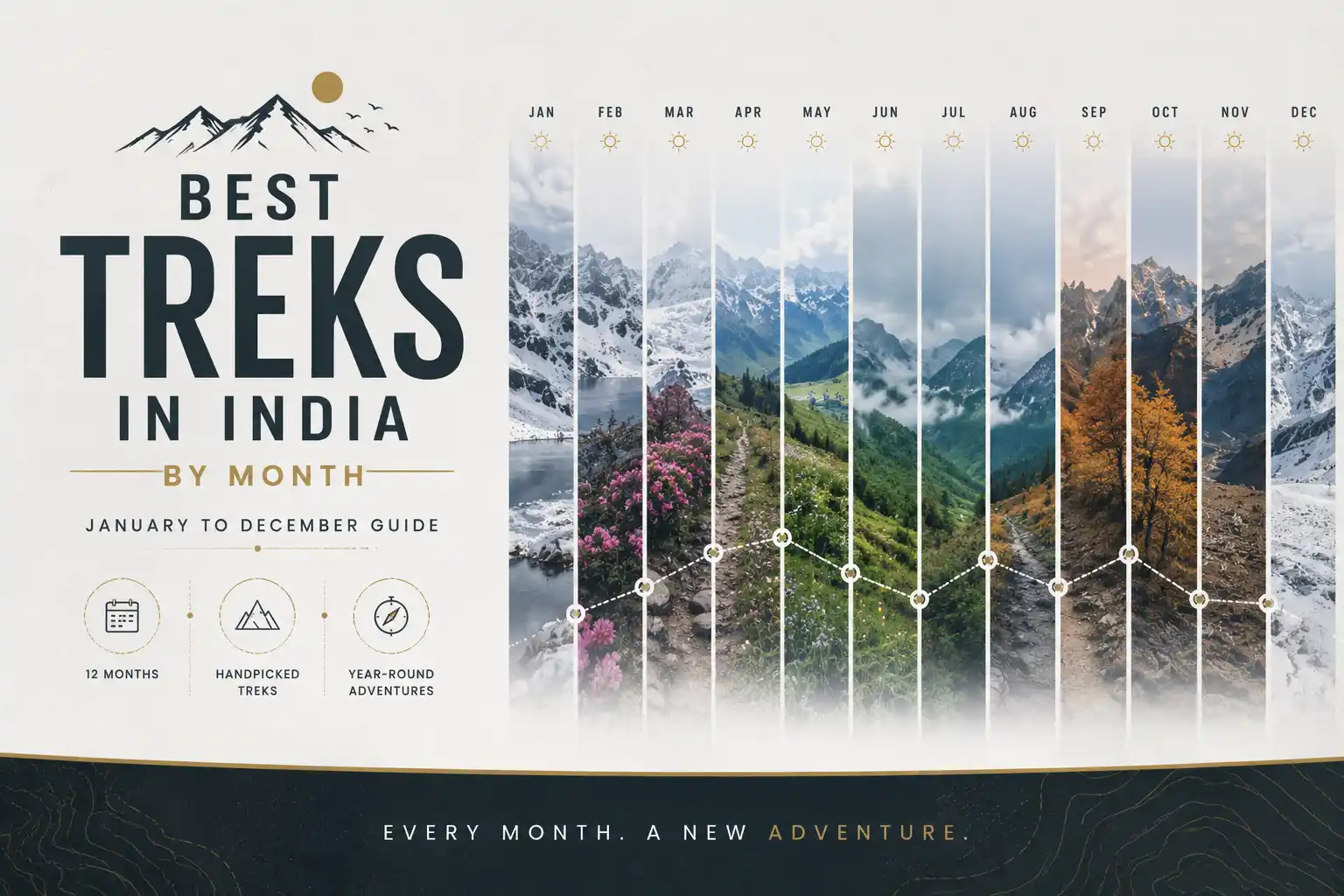
Best Treks in India by Month: January to December Guide
There is no single best trek in India. The Himalayan landscape changes completely with the seasons. In January, you could be walking through deep snow in Uttarakhand. By May, the same mountains may be covered in green forests and open meadows. Come August, the Valley of Flowers is bursting with colour, while October brings some of the clearest mountain views of the year. So instead of asking “Which are the best treks in India by month?”, a better question is: “Which would be a suitable trek for the month I want to travel in?”
Here’s a month-by-month guide to help you find the right one.
Best Treks in India by Month
| Month | Recommended Treks |
|---|---|
| January | Kedarkantha, Brahmatal, Gulabi Kantha, Dayara Bugyal |
| February | Kedarkantha, Brahmatal, Gulabi Kantha, Chopta–Chandrashila |
| March | Chopta–Chandrashila, Dayara Bugyal, Kuari Pass |
| April | Pangarchulla, Kuari Pass, Har Ki Dun, Dayara Bugyal |
| May | Pangarchulla, Bali Pass, Har Ki Dun, Ali Bedni Bugyal |
| June | Hampta Pass, Bali Pass, Pangarchulla, Roopkund |
| July | Valley of Flowers, Hampta Pass |
| August | Valley of Flowers |
| September | Valley of Flowers, Roopkund, Hampta Pass |
| October | Roopkund, Pangarchulla, Kuari Pass, Har Ki Dun |
| November | Kuari Pass, Har Ki Dun, Nag Tibba |
| December | Kedarkantha, Brahmatal, Gulabi Kantha, Dayara Bugyal |
Trail conditions and opening dates can change with weather, snowfall, permissions and local regulations.
January & February: Chase the Snow
If snow is what brought you to the Himalayas, January and February are the months to look at.
Kedarkantha remains one of India’s most popular winter treks, with snow-covered forests, campsites and a beautiful summit section.
Brahmatal is another excellent choice, especially if you want snowy trails and wide Himalayan views.
For something a little different, Gulabi Kantha is a beautiful winter option. Its open landscapes look completely different when covered in snow and offer a quieter alternative to some of the more crowded winter routes.
Chopta–Tungnath–Chandrashila is another option for a shorter winter adventure, although snowfall can affect accessibility.
Best for: Snow, winter landscapes and first-time winter trekkers.
March & April: Winter Meets Spring
March is a transition period in the mountains.
Snow can still be found at higher elevations, while lower sections begin turning green. By April, spring trekking starts becoming much more attractive.
Kuari Pass and Dayara Bugyal are good choices during this period, while Pangarchulla can offer a combination of spring landscapes and remaining snow at higher elevations.
If you prefer valleys and forests rather than summit pushes, Har Ki Dun is another excellent spring option.
This is a great time to trek if you want something between the extremes of winter and summer.
Best for: Spring landscapes, remaining snow and moderate weather.
May & June: High-Altitude Trekking Season
May and June are among the most versatile months for Himalayan trekking in India.
The weather becomes more comfortable, many high-altitude routes open up and the monsoon hasn’t fully arrived yet.
Pangarchulla is ideal for trekkers looking for a challenging summit, while Bali Pass takes things a step further with demanding high-altitude terrain connecting the Tons and Yamuna valleys.
For a completely different experience, Har Ki Dun takes you through forests, villages and a beautiful Himalayan valley.
Hampta Pass becomes particularly attractive in June. The trek is famous for its dramatic change in scenery, moving from green Himalayan valleys to the stark landscapes of Lahaul.
Roopkund can also be considered during this period, depending on official permissions and current trail conditions.
Best for: High-altitude adventures, mountain passes and experienced trekkers.
July & August: Head to the Valley of Flowers
Monsoon isn’t usually the first season people associate with trekking.
But there is one place where the rain creates something spectacular.
Valley of Flowers.
From July through August, the famous alpine valley transforms into a colourful landscape filled with wildflowers, waterfalls, streams and lush green mountains.
August is particularly attractive if flowers are your priority.
However, monsoon conditions can make mountain roads and trails unpredictable, so this isn’t a season where you should simply arrive without checking the latest weather and route conditions.
Best for: Flowers, greenery, photography and monsoon landscapes.
September & October: Clear Skies and Big Mountain Views
If you’re looking for clear Himalayan views, September and October are hard to beat.
The monsoon begins to disappear, the skies clear and the mountains become incredibly sharp against the blue sky.
Early September can still be excellent for Valley of Flowers, while Roopkund, Pangarchulla, Kuari Pass and Har Ki Dun become attractive options as autumn settles in.
October is especially popular for high-altitude trekking because the weather is generally pleasant and visibility can be excellent.
The downside?
Everyone knows it.
October can get busy.
Best for: Clear skies, photography and panoramic Himalayan views.
November & December: Winter Is Coming Back
By November, temperatures begin dropping again and the mountains slowly transition back towards winter.
Kuari Pass, Har Ki Dun and shorter treks such as Nag Tibba can be good choices depending on conditions.
By December, snow trekking becomes the main attraction again.
Kedarkantha, Brahmatal, Gulabi Kantha and Dayara Bugyal are all worth considering for a winter adventure.
If you’re planning to trek around Christmas or New Year, booking early is a good idea because winter treks can become surprisingly busy.
Best for: Early winter landscapes and the return of snow.
So, When Should You Go Trekking in India?
It really depends on what you want to see.
Want snow?
Go between December and February.
Want spring landscapes?
Try March to May.
Want challenging high-altitude treks?
May and June are excellent choices.
Want flowers?
July and August are the months for Valley of Flowers.
Want clear mountain views?
September and October are hard to beat.
And that’s what makes trekking in India so interesting. There isn’t one perfect trekking season.
There’s a different version of the Himalayas waiting for you every few months.
Whether you want the snow-covered trails of Kedarkantha and Gulabi Kantha, the summit challenge of Pangarchulla, the demanding terrain of Bali Pass, the dramatic landscapes of Hampta Pass, the mystery of Roopkund, or the colourful meadows of Valley of Flowers, there’s a trek for almost every month of the year.
You just need to choose the right one.
Checkout our Treks and lets us help you find the perfect trek for you, Contact us!
Follow us on Instagram for Regular Updates!

Recent Posts
Is Gulabi Kantha Trek Worth It? An Honest Guide for 2026

Is Kedarkantha Difficult for Beginners? An Honest 2026 Guide
Quick booking process
+91 9557062166