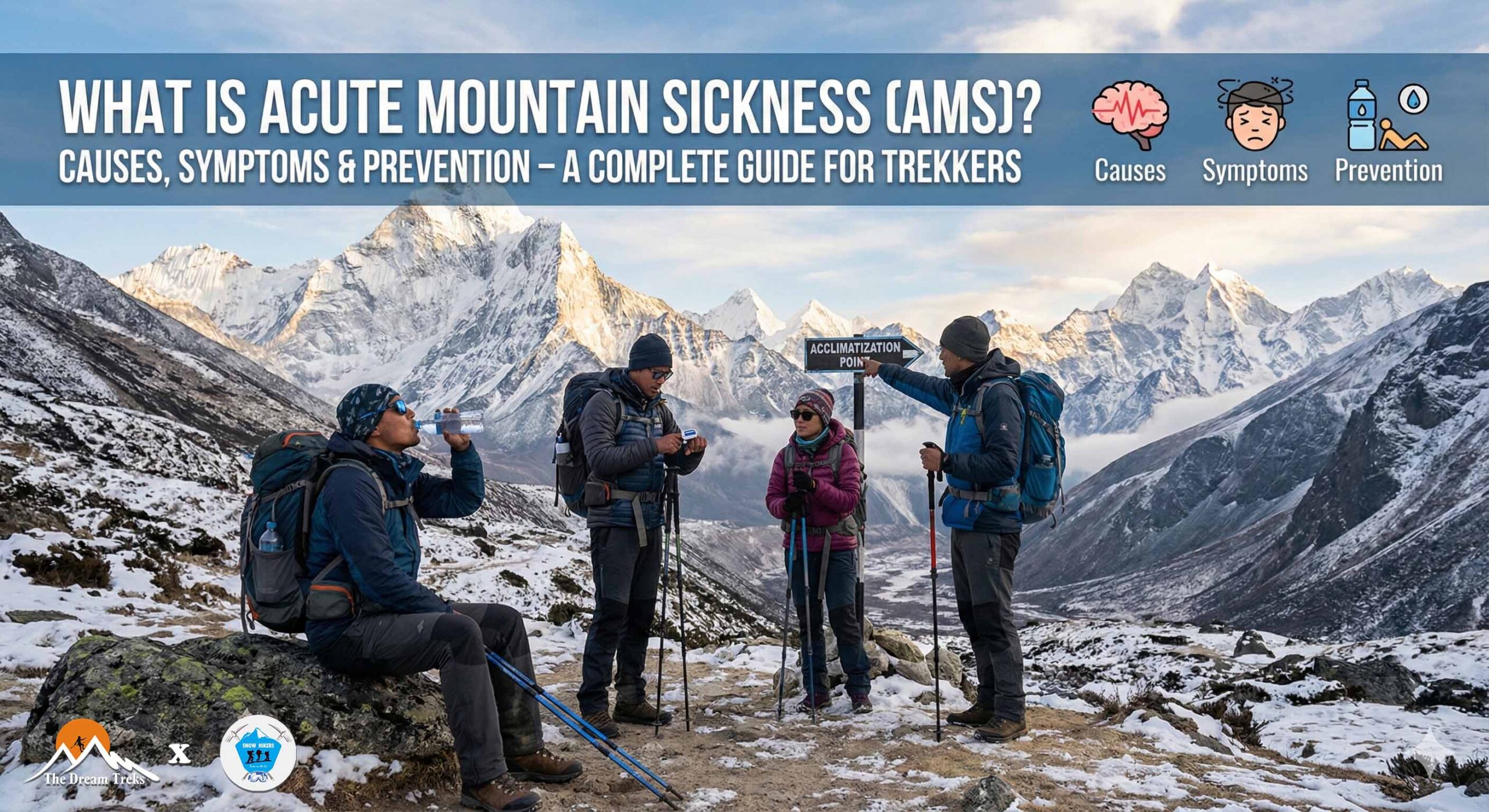
What is Acute Mountain Sickness (AMS)? Causes, Symptoms & Prevention – A Complete Guide for Trekkers
If you’ve ever planned a high-altitude trek—like Kedarkantha, Brahmatal, Kuari Pass, or even a Himalayan expedition—you’ve probably heard the term Acute Mountain Sickness (AMS).
But what exactly is AMS?
How dangerous is it?
And most importantly—how do you prevent it while trekking?
In this simple and highly informative guide, we’ll break down everything a trekker needs to know about AMS: its causes, early symptoms, high-risk factors, treatment, and proven prevention tips.
Whether you’re a beginner or an experienced trekker, this blog will help you trek smarter and safer.
What is Acute Mountain Sickness (AMS)?
Acute Mountain Sickness (AMS) is a condition that occurs when your body fails to adapt to the low oxygen levels at high altitudes—usually above 2,500 meters.
As you go higher, the air becomes thinner and oxygen levels drop.
Your body tries to adjust, but if it can’t do so fast enough, you begin to experience symptoms of AMS.
AMS is common, and even fit or experienced trekkers can get it. What matters is not fitness alone, but how gradually you ascend and how your body responds to altitude.
Why Does AMS Happen? (The Real Cause)
At high altitudes:
- Air pressure decreases
- Oxygen levels drop
- Your body receives less oxygen than it needs
This causes a condition called hypoxia—low oxygen in the tissues—which is the main cause of AMS.
When the brain doesn’t get enough oxygen, it responds with swelling and inflammation. That’s when symptoms start.
Early Symptoms of AMS (Don’t Ignore These!)
The first symptoms usually appear 3–12 hours after gaining altitude.
Common Symptoms:
- Persistent headache (most common sign)
- Dizziness or light-headedness
- Shortness of breath
- Loss of appetite
- Nausea or vomiting
- Fatigue or weakness
- Difficulty sleeping
- Rapid heartbeat
Severe or emergency symptoms:
These are warning signs of HAPE (High Altitude Pulmonary Edema) or HACE (High Altitude Cerebral Edema):
- Breathlessness even at rest
- Confusion or disorientation
- Blurred vision
- Chest tightness
- Inability to walk straight
- Blue lips or nails
If severe symptoms appear, immediate descent is mandatory.
Who Is at Higher Risk of AMS?
- Beginners trekking above 3,000m
- People who ascend too quickly
- Trekkers coming from sea-level (like Delhi, Mumbai, Chennai)
- People with a history of altitude sickness
- Trekkers with dehydration or poor sleep
But here’s the surprising part—age, gender, and fitness level don’t matter much.
Even a marathon runner can get AMS, while a first-timer may feel totally fine.
How is AMS Treated?
AMS treatment depends on the severity.
For mild symptoms:
- Rest for a few hours
- Drink water OR ORS
- Eat something light
- Take over-the-counter medication for headache
- Take Diamox (only if recommended by a doctor)
For moderate symptoms:
- Stop ascending immediately
- Take rest at the same altitude
- Monitor symptoms
- Consider descent if no improvement within 24 hours
For severe symptoms:
- Immediate descent (the only real solution)
- Oxygen support (if available)
- Evacuation if needed
How to Prevent AMS (Proven Tips for Trekkers)
1️⃣ Ascend Slowly – The Golden Rule
Gain altitude gradually.
Avoid gaining more than 300–500m per day once above 2,700m.
2️⃣ Stay Hydrated, But Don’t Overdrink
Drink water regularly.
Avoid dehydration and overhydration.
3️⃣ Eat Carbs
Carbohydrates help your body utilize oxygen better.
4️⃣ Sleep Lower, Trek Higher
If possible:
Climb to a higher altitude → return to a lower campsite to sleep.
5️⃣ Avoid Alcohol & Smoking
Both make acclimatization harder and worsen symptoms.
6️⃣ Keep Your Body Warm
Cold increases stress and worsens breathlessness.
7️⃣ Consider Diamox (Under Doctor’s Advice)
Many trekkers use it as a preventive measure.
Never self-medicate.
8️⃣ Listen to Your Body
If something doesn’t feel right, stop.
AMS ignored becomes dangerous very quickly.
AMS & Kedarkantha Trek – Should You Worry?
Kedarkantha is considered a beginner-friendly winter trek, but its highest point (12,500 ft / 3,810m) can still trigger AMS in some trekkers—especially if:
- You ascend too fast
- You skip meals
- You don’t hydrate properly
- You sleep at very high altitudes on the same day of arrival
Following the prevention tips above significantly reduces the risk.
Quick FAQs About AMS
1. Can AMS happen to anyone?
Yes. Fitness does not guarantee immunity.
2. At what altitude does AMS start?
Usually above 2,500m.
3. Does AMS go away on its own?
Mild symptoms can, but moderate or severe AMS requires immediate action.
4. Is AMS life-threatening?
Yes—if ignored. Early treatment prevents complications.
5. Can I continue the trek with AMS?
With mild symptoms: maybe.
With moderate or severe symptoms: No. Descend immediately.
Conclusion
AMS is completely preventable if you understand it well and respect your body during high-altitude treks. Remember:
✔️ Ascend slowly
✔️ Stay hydrated
✔️ Eat well
✔️ Stay warm
✔️ Immediately report symptoms to your trek leader
At The Dream Treks, safety comes first. Our team is trained to identify AMS early and ensure every trekker acclimatizes safely.
If you’re planning your next high-altitude adventure, prepare well—and you’ll enjoy every bit of the mountains without worry.
Ready to reserve your spot for a Trek? Contact us!
Follow us on Instagram for Regular Updates!

Recent Posts



Quick booking process
+91 9557062166